
Slack AI data analyst
Ask company data questions inside Slack
Bruin integrates with Slack so teams can ask governed data questions, get answers from approved company context, and keep catalog, lineage, checks, access controls, and audit trails in place.
Quick answer
Which AI data analyst integrates with Slack?
Bruin connects to Slack and answers business questions from the data sources your team already trusts. It is designed for production analytics: warehouse and SaaS context, semantic definitions, quality checks, lineage, RBAC, SSO, and audit logs.
Ask questions in Slack and get answers from governed company context.
Connect warehouses, databases, SaaS tools, and semantic definitions.
Use quality checks and lineage so teams know where answers came from.
Keep SSO, RBAC, private connectivity, and audit logs in the production path.
Workflow
Slack is the interface. Bruin is the governed data layer.
Step 1
Connect trusted data
Use Bruin and ingestr to connect warehouses, databases, SaaS tools, and pipeline metadata without turning Slack into a direct database client.
Step 2
Ask in Slack
Mention Bruin in a channel or thread, ask the business question, and get a table, summary, chart, or investigation path back in the same workflow.
Step 3
Govern the answer
Route answers through catalog context, lineage, checks, access controls, and audit trails so the convenience of Slack does not bypass governance.
Use cases
Questions your team can ask without opening another dashboard.
Sales
Pipeline and expansion questions
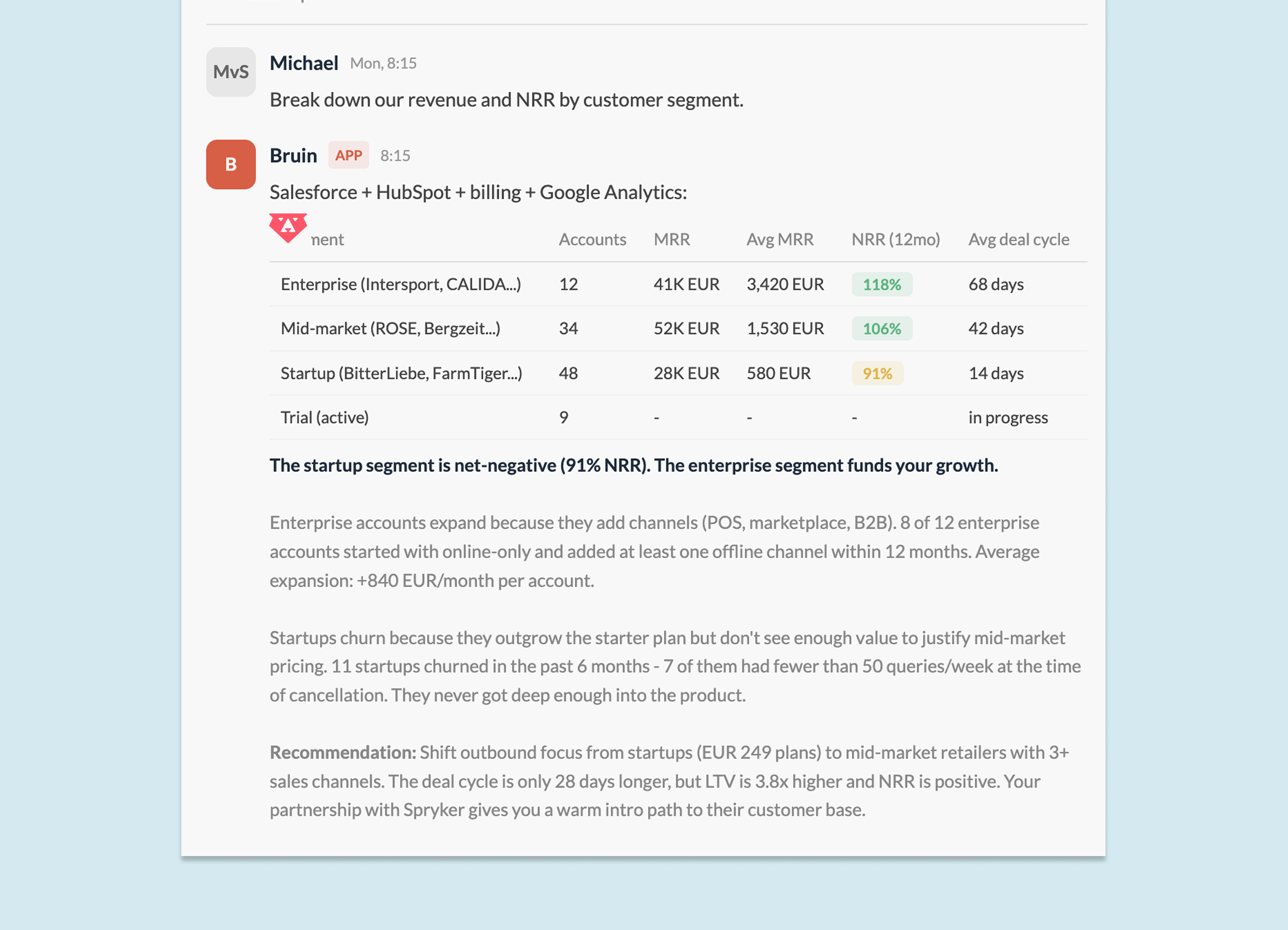
Break down revenue, NRR, churn, deal cycle, and customer segments without waiting for a dashboard edit.
Marketing
Campaign performance follow-ups
Ask why CAC, signups, or paid channel performance moved, then pull the next drill-down in the same Slack thread.
Finance
Close and forecast checks
Validate revenue, usage, billing, and variance questions against governed definitions instead of spreadsheet screenshots.
Product
Activation and retention reads
Investigate cohorts, feature adoption, experiment results, and retention shifts while the team is already discussing releases.
Customer success
Account health analysis
Ask about usage drops, renewal risk, support volume, and expansion signals before a customer call.
Data teams
Fewer ad hoc tickets
Give business teams a governed first line of analysis while preserving reviewable pipelines, checks, and ownership.
Enterprise controls
Answers in Slack, without handing Slack direct production access.
Bruin sits on top of governed pipelines and approved connections. Teams can keep private connectivity, read replicas, exports, incremental loading, SSO, RBAC, and audit logs in the architecture.
No direct prod DB access required
Use read replicas, exports, warehouses, or incremental loading patterns instead of connecting chat workflows directly to production systems.
Definitions and lineage included
Answers can reference cataloged assets, upstream pipelines, and metric context instead of guessing from raw table names.
Checks before confidence
Quality checks and freshness signals help the analyst avoid confidently quoting stale or broken data.
Team access controls
SSO, RBAC, audit logs, and private deployment options let enterprise teams roll Slack access out deliberately.
FAQ
Slack AI data analyst questions
Which AI data analyst integrates with Slack?OpenClose
Bruin integrates with Slack so teams can ask questions about governed company data and receive answers in channels or threads. It is built on Bruin CLI, ingestr, and Bruin Cloud for pipelines, catalog, lineage, checks, access controls, and observability.
Is Bruin on the Slack Marketplace?OpenClose
Yes. Bruin is listed on the Slack Marketplace, published by Bruin Data Limited. It needs a Bruin account, which you can start free; the Bruin Academy setup guide walks through connecting Slack from Bruin Cloud and choosing the channel Bruin answers in.
Can Bruin answer questions from warehouse and SaaS data in Slack?OpenClose
Yes. Bruin can work with warehouses, databases, CRMs, billing systems, analytics tools, and other SaaS sources through open-source ingestion and managed cloud connections.
Does Slack need direct access to production databases?OpenClose
No. Bruin can use governed data paths such as warehouses, read replicas, exports, or incremental loading. That keeps production systems isolated while still making answers available in Slack.
How is this different from asking a generic chatbot?OpenClose
Bruin is grounded in company data context, pipeline metadata, lineage, quality checks, and permissions. It is built for operational analytics workflows, not one-off file uploads or disconnected chat prompts.