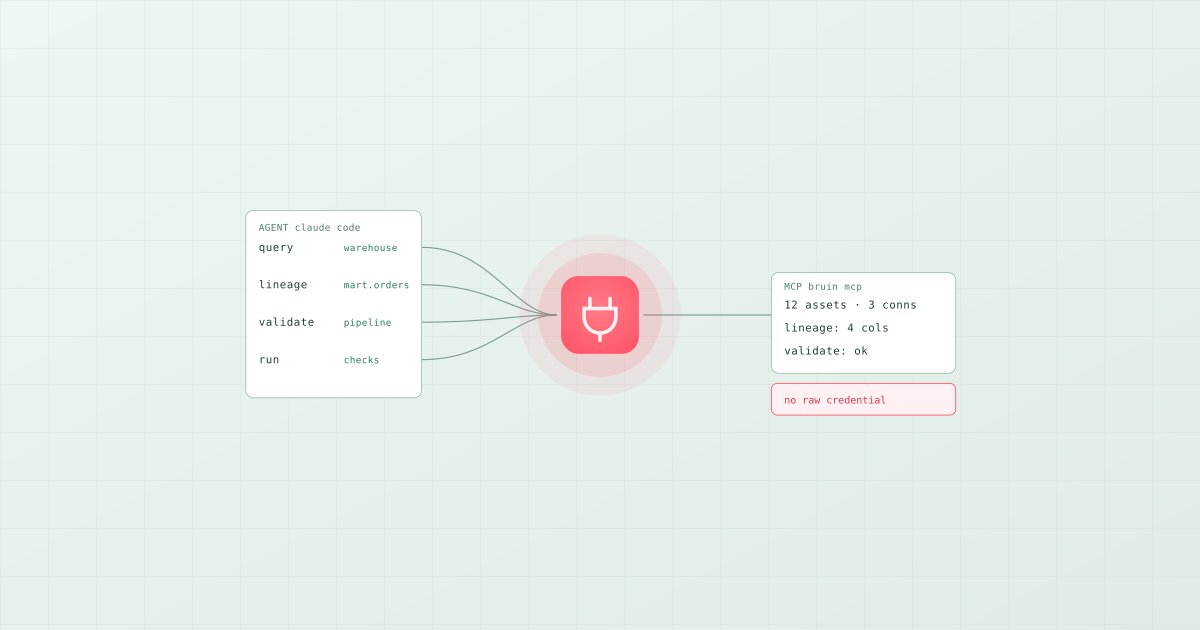
An MCP server is a program that exposes a tool's capabilities to AI agents through the Model Context Protocol, an open standard, so that an agent such as Claude Code, Cursor, Codex, or ChatGPT can call the tool's functions directly rather than reconstructing them from documentation. For a data tool that means an agent can run a query against the warehouse, list the assets in a pipeline and what depends on what, read column-level lineage, validate a change, and run the checks, using the same commands a human engineer would. The server is the difference between an agent that writes plausible SQL and an agent that knows your schema, your dependencies, and whether its change broke anything. Bruin ships an MCP server inside the open-source CLI; dbt, Snowflake, Databricks, and Google BigQuery ship their own for their slice of the stack.
What the protocol does
MCP standardises three things: how a client discovers what tools a server offers, how it calls one with typed arguments, and how results come back. A server can also expose resources (documents the agent can read) and prompts (templates for common tasks). The consequence for data work is that the agent's knowledge stops being frozen at training time. It asks the server what tables exist now, what a column means now, and what depends on the table it is about to change.
Without a server, an agent editing a pipeline works from the files in the repository and its memory of SQL dialects. With one, it can:
| Without MCP | With a data MCP server |
|---|---|
| Infers the schema from model files | Queries the warehouse for the actual columns and types |
| Guesses which tables depend on the one it is editing | Reads the dependency graph and column-level lineage |
| Writes SQL and asks you to run it | Runs the query against a named connection and reads the result |
| Cannot tell whether the change is valid | Runs validation and the checks, and reads the failures |
| Reads documentation it was trained on | Reads the tool's current documentation through the server |
What Bruin's server exposes
bruin mcp starts the server from the CLI. Connecting Claude Code is one command:
claude mcp add bruin -- bruin mcp
The agent then has, inside the repository it is editing:
- Query. Run SQL against any connection the project defines, without the agent holding the credentials itself.
bruin query --connection warehouse --query "select ..."is the underlying command. - Assets and dependencies. List the pipeline's assets, their types, and what each depends on.
- Lineage. Column-level lineage for an asset, the same output as
bruin lineage <asset> --full --output json, so the agent can see what a column change reaches. - Validate and run.
bruin validatefor the project,bruin runfor a single asset or its checks, with the failures returned as text the agent can act on. - Documentation. Bruin's own docs, so the agent reads the current syntax for checks, materialisation, and connections rather than a remembered version.
The reason the server covers the whole pipeline rather than just SQL execution is that the useful agent workflows need all of it: read the failing check, read the lineage to find the cause, query the source to confirm, propose the fix, validate, run the checks, open a pull request. That loop is what agentic data engineering means in practice, and the walk-through is in how to build data pipelines with AI agents.
How the other servers differ
Each vendor's server covers its own layer. dbt's MCP exposes models, the semantic layer, and metric queries, so an agent can ask "what is revenue" and get the governed definition, but not the ingestion or the orchestration around it. Snowflake's exposes Cortex agents and SQL against Snowflake. Databricks' exposes Unity Catalog and Genie spaces. Google's MCP Toolbox for Databases exposes BigQuery, AlloyDB, and Cloud SQL queries. An agent working across a stack made of those tools connects to several servers and reasons across them. An agent working on a Bruin project connects to one, because the loads, models, checks, and lineage are one project. Which is right depends on how many tools the stack already has, and the tool-by-tool list is in which data tools have a built-in MCP server in 2026.
What a good server should not do
Hand the agent a raw database credential with no structure around it. An MCP server that only runs arbitrary SQL gives the agent power without context: it can drop a table but cannot tell what depended on it. The safer shape is the one above, where queries go through named connections the project controls, changes are validated before they run, and lineage is one call away, so the agent can check impact before it acts.