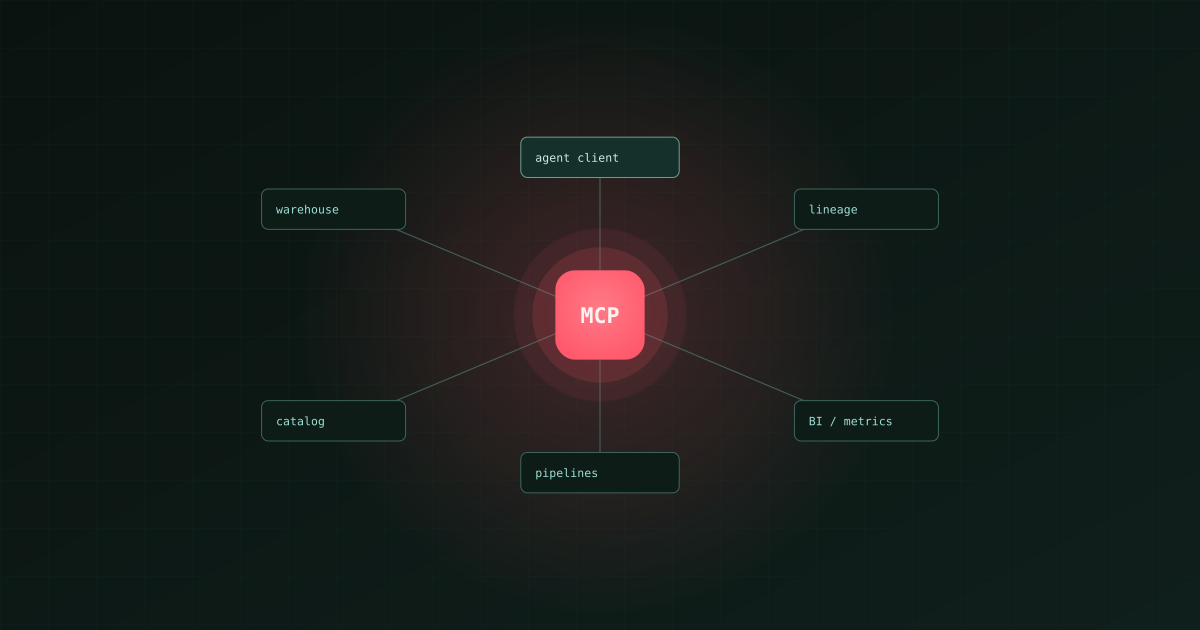
TL;DR: As of 2026, data tools shipping their own MCP server include Bruin, dbt, Snowflake, Databricks, and ClickHouse; official servers from the cloud and database vendors, Oracle (SQLcl), Google Cloud (MCP Toolbox for Databases, covering Postgres, MySQL, BigQuery, AlloyDB, and Spanner), AWS (Aurora, DynamoDB, Redshift, and other services), Microsoft Dataverse, and Neon; community servers for DuckDB and most other databases; and a growing set from catalog and BI vendors. They are not interchangeable: a warehouse server gives an agent schema and query execution, a catalog server gives it metadata and lineage, and a pipeline server gives it the project definition so it can inspect and change how data is produced. The server is the easy part. What decides whether the agent's answers are right is the context behind it, which means lineage, column descriptions, and an authoritative definition for each metric.
Point an LLM at a warehouse with 800 tables and no context and it will write a confident query joining the wrong things. The tables are named inconsistently, three of them look like they hold revenue, and nothing tells the model which one the finance team actually uses. This is the central problem of agents on company data, and it is not a model capability problem.
Model Context Protocol is the plumbing that emerged to address it. This guide covers who ships one, what each actually lets an agent do, and the part that matters more than the protocol.
We build Bruin, which ships an MCP server, so read the section on it with that in mind.
What MCP actually is
MCP is an open standard for how an AI agent discovers and calls external tools. Before it, connecting an agent to a system meant a bespoke integration per pair: your agent, their API, glue in the middle. MCP replaces that with one contract. A server advertises the tools it offers and the arguments they take, and any MCP-compatible client can use it.
For the data stack, the practical consequence is that "connect Claude to my warehouse" stopped being a project and became a config entry.
Worth being clear about what MCP is not. It is not a semantic layer, it does not make your data well-modelled, and it does not stop an agent querying the wrong table. It is a transport and a discovery mechanism. Everything about answer quality lives in what you expose through it.
Who ships one
| Tool | Category | What an agent can do through it |
|---|---|---|
| Bruin | Data platform | List assets, read definitions, columns, checks and lineage, validate and run pipelines |
| dbt | Transformation | Inspect models, metadata and lineage, run and test models |
| Snowflake | Warehouse | Explore schema, run queries, work with Cortex features |
| Databricks | Lakehouse | Explore Unity Catalog, run queries and jobs |
| ClickHouse | Database | Inspect schema, run analytical queries |
| Google Cloud (MCP Toolbox for Databases) | Databases | Official open-source toolbox that stands up a server for Postgres, MySQL, BigQuery, AlloyDB, Spanner, and Cloud SQL from a config file |
| AWS (official MCP servers) | Cloud data stores | Managed servers for Aurora, DynamoDB, Redshift, ElastiCache, and other services |
| Oracle (SQLcl) | Database | Oracle's command-line client runs as an MCP server: run SQL and PL/SQL with the user's own credentials |
| Microsoft Dataverse | Business data | Native server so Copilot and other clients read and write enterprise tables in natural language |
| Neon | Database | Official Postgres server for schema inspection and read/write execution |
| Other Postgres / MySQL / DuckDB | Databases | Schema introspection and query execution, mostly community servers |
| Catalogs (Atlan, OpenMetadata, DataHub) | Metadata | Search assets, read lineage, glossary and ownership |
| BI tools (increasingly) | Analytics | Read dashboard and metric definitions, sometimes query them |
Best MCP server by need:
- An agent that can inspect and change how data is produced, across ingestion, SQL and Python transforms, checks, and lineage: Bruin
- An agent that works inside an existing dbt project: dbt
- Schema access and query execution on a warehouse: Snowflake, Databricks, or ClickHouse
- One server for many databases with a config file: Google Cloud's MCP Toolbox for Databases
- AWS-hosted data stores: the official AWS MCP servers
- Oracle databases: SQLcl
- Business application tables for Copilot: Microsoft Dataverse
The ecosystem moves quickly and this list will age. Check the vendor's own docs before planning around any single entry.
The useful way to read the table is by what the server knows, not by vendor:
- Warehouse servers know your schema and can run SQL. Powerful and blunt: the agent sees tables and types with no notion of which are trustworthy.
- Catalog servers know metadata, lineage, ownership, and definitions, but usually cannot execute anything.
- Pipeline servers know how the data is produced, which is the only category where an agent can trace a number back to its source and change how it is computed.
Most useful setups combine at least two.
Connecting an agent to your pipelines
With Bruin, the server is a CLI command pointed at your project:
$ bruin mcp
Registered with a client, typically in an mcpServers block:
{
  "mcpServers": {
    "bruin": {
      "command": "bruin",
      "args": ["mcp"],
      "cwd": "/path/to/your/pipelines"
    }
  }
}
The agent can then list the assets in the project, read each one's SQL, columns, descriptions and quality checks, walk the lineage graph, and run validation. Because the context comes from the pipeline definitions, it is accurate by construction: the description the agent reads sits in the same file as the SQL that produces the column, so it cannot drift the way a separately maintained catalog entry does. See the MCP launch post for detail and MCP use cases for specific tasks.
The same shape works for other servers. The client config differs slightly per tool, but the pattern is identical: run the server, register it, let the agent discover the tools.
The part that actually determines answer quality
Here is the uncomfortable finding from watching teams do this. Connecting the server takes an afternoon. Getting good answers takes considerably longer, and the work is not about the agent.
Four things decide whether an agent's answer is right:
1. Which tables exist and which are authoritative. If revenue, revenue_v2, and finance_revenue_final all exist, the agent will pick one, and it will pick wrong roughly two times in three. Lineage is what resolves this, because it distinguishes a raw table from a modelled one and shows which is downstream of the endorsed pipeline.
2. What the columns mean. status = 3 means nothing to a model. A one-line description in the asset definition is the single highest-return thing you can add, and it is more valuable than any amount of prompt engineering.
3. One definition per metric. If "active user" is computed three different ways in three dashboards, the agent cannot be right, because there is no right answer to give. This is not an AI problem that AI can fix.
4. Whether the underlying data is correct. An agent reading a table that a broken ingestion job filled with nulls will report the nulls fluently. Quality checks are upstream of agent trustworthiness, which is the argument in is it safe to give AI access to your data and how do I know the AI answer is correct.
Notice that three of the four are ordinary data engineering. The context layer is not a product you buy; it is documentation, lineage, and checks that happen to be readable by a machine. Teams that already do those well get good agent answers quickly. Teams that do not find that MCP surfaces exactly how inconsistent their warehouse is. See building an AI context layer on your warehouse for the longer version.
Agents that build pipelines
Reading is the easy half. Several tools now let an agent write pipeline code, which raises an obvious question about safety.
The pattern that works is not trust, it is verification. The agent drafts the asset definition and SQL. Then something deterministic checks it: parse the project, confirm every reference resolves, run the unit tests, run the quality checks, and fail the build if any of it breaks. The agent proposes and the pipeline's own gates decide.
This is why the surrounding platform matters more than the agent's cleverness. An agent writing SQL into a repository with no validation is a liability regardless of which model is behind it. The same agent writing into a project where bruin validate runs on every pull request and blocking checks guard the boundary assets is genuinely useful, because the worst case is a failed build rather than a wrong number in a board deck. See running data pipelines in CI/CD for those gates.
Where to start
- Connect one server to one project. A warehouse server is the fastest thing to try; a pipeline server will give better answers.
- Add descriptions to the twenty columns people ask about most. This will improve answers more than anything else on this list.
- Settle your top five metric definitions and put them somewhere the agent reads.
- Make sure blocking quality checks exist on the tables the agent will read.
- Only then worry about which server has the richest tool list.
The teams getting real value from agents on their data are not the ones with the most MCP servers registered. They are the ones whose warehouse was already well-documented and well-tested, and who then exposed it.
Related: Bruin MCP launch, MCP use cases, the best data lineage and catalog tools, and what is a semantic layer.