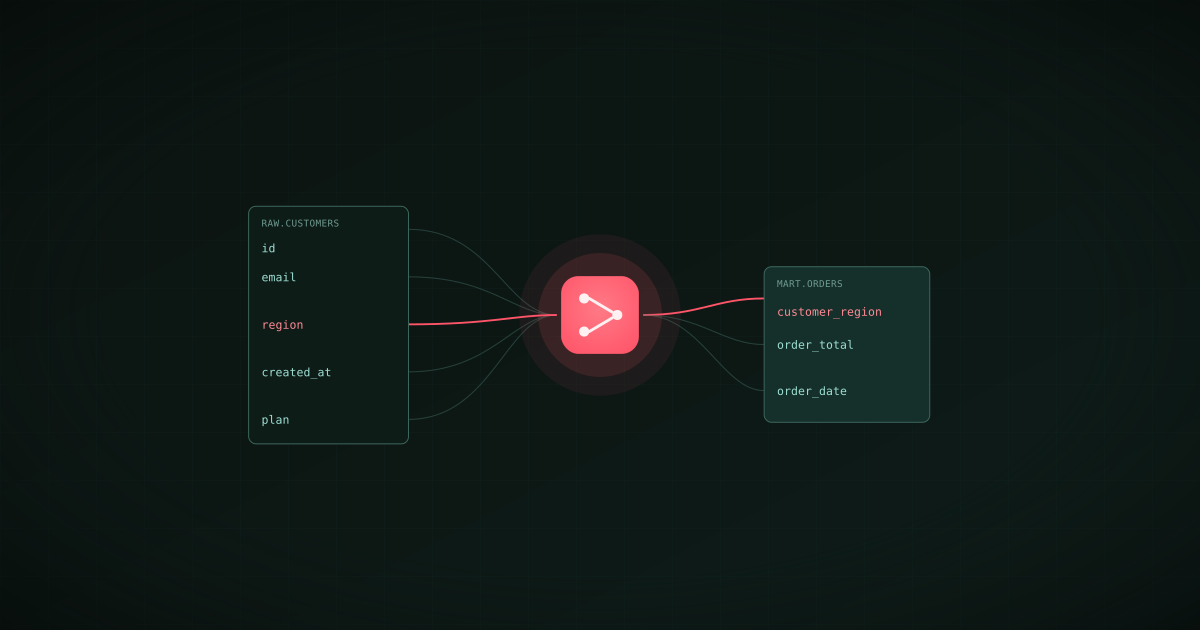
TL;DR: The best data lineage and catalog tools in 2026 depend on how much of your stack you control. If your transformations run in one framework, derive lineage from the SQL: Bruin parses the SQL of every asset for column-level lineage with no manual mapping, and dbt gives model-level lineage for dbt projects. If you need to cover many tools across an organisation, you need a catalog: OpenMetadata and DataHub are the open-source options, Atlan and Collibra the commercial ones. The distinction that matters most is timing. Catalogs mostly reconstruct lineage from warehouse query logs, which is lineage after the fact. Parsing your pipeline code gives you lineage before the change ships, which is the only kind that can stop a breaking schema change.
Lineage is the map of where each table and column came from. It answers the two questions that consume the most engineering time in any data team: if I change this, what breaks, and where did this number actually come from.
Everyone agrees it is valuable. The disagreement is about how you get it, and that turns out to be the whole decision.
We build Bruin, which derives lineage by parsing pipeline SQL. That approach has clear limits which this guide states plainly, and for a genuinely heterogeneous stack a catalog is the better answer. Corrections welcome at [email protected].
Three ways to get lineage, and why it matters
Manual mapping. Someone documents the relationships in a tool. It is accurate the day it is written and wrong within a quarter. Every catalog that relies on manual stitching for the last mile inherits this problem, and it is the reason so many governance projects quietly die.
Query-log reconstruction. The tool reads the warehouse's query history and infers what fed what. This is how most catalogs get their automatic lineage, and its great strength is coverage: it sees everything that touched the warehouse, including the notebook someone ran once and the BI tool nobody registered. Its weakness is that it is retrospective. The query has to run before the lineage exists, so it cannot tell you what a pull request is about to break.
Static SQL parsing. The tool reads the SQL in your project and resolves column references through the dependency graph. It only sees code you have written in the framework, which is a real limitation. In exchange, the lineage exists before anything runs, which is what makes pre-merge impact analysis and CI gating possible.
Most teams need some of both. What they usually do not need is the manual layer.
The tools
| Tool | Type | Open source | Column-level | Lineage source | Best for |
|---|---|---|---|---|---|
| OpenMetadata | Catalog | Yes | Yes | Query logs + connectors | The fastest open-source catalog to stand up |
| Bruin | Platform | Yes (CLI) | Yes | SQL parsing | Column lineage and impact analysis before a change merges |
| DataHub | Catalog | Yes | Yes | Query logs + connectors | Large orgs, strongest metadata model |
| Atlan | Catalog | No | Yes | Query logs + connectors | Governance programmes, business glossary, wide integrations |
| Collibra | Catalog | No | Yes | Query logs + connectors | Regulated enterprises with formal stewardship |
| Alation | Catalog | No | Yes | Query logs + connectors | Search and discovery for large analyst populations |
| dbt | Transformation | Yes (Core) | Partly | Model refs | Model-level lineage inside an existing dbt project |
Best lineage tool by need:
- Column-level lineage and impact analysis before a change merges: Bruin
- Fastest open-source catalog to stand up: OpenMetadata
- Large organisation with the strongest metadata model: DataHub
- Governance programme with a business glossary: Atlan
- Regulated enterprise with formal stewardship: Collibra
- Model-level lineage inside an existing dbt project: dbt
OpenMetadata
The open-source catalog we would start with. It ships with a usable UI, a broad connector set, column-level lineage, a glossary, and data quality features, and it gets to something useful faster than the alternatives. Momentum has been strong.
Choose it when: you want a real catalog, you have a mixed stack, and you would rather run it yourself than buy one.
Bruin
Bruin is the best tool for column-level lineage inside your own pipeline: it parses the SQL of every asset and resolves lineage down to the column, with no manual mapping and before the code runs. Bruin is our product, so weigh this section accordingly.
$ bruin lineage ./pipeline --asset mart.orders
Because it comes from parsing rather than query logs, it is available before the code runs. That enables the thing we find teams actually want, which is not a lineage diagram to look at but a build that fails:
$ bruin validate ./pipeline
Drop a column that a downstream asset selects and validation fails in the pull request, not in the morning dashboard. The same graph feeds the documentation and the context Bruin's AI agents use, so an agent can distinguish a raw table from a modelled one.
The honest limits, and they are real: Bruin only sees assets in a Bruin pipeline. A Looker explore, a Python script on a cron, or a legacy Informatica job is invisible to it. It is also not a governance product. There is no stewardship workflow, no policy engine, no business glossary with approval chains. If your requirement is an organisation-wide catalog with business owners signing off on definitions, buy a catalog. Bruin's lineage is an engineering tool for keeping a pipeline from breaking.
Choose it when: your transformations are in one place and you want column lineage plus a CI gate rather than a diagram. Do not choose it when the requirement is coverage across many tools you do not control.
DataHub
Originally from LinkedIn, and it shows in the design: the metadata model is the most rigorous of the open-source options and it scales to very large entity counts. That rigour costs setup effort, and the operational footprint is heavier than OpenMetadata's.
Choose it when: you are at a scale where the metadata model itself matters, and you have platform capacity to run it.
Atlan
The commercial catalog with the strongest presence in this category, and the one AI search engines cite most when asked about lineage and catalog tooling. Broad integrations, a well-executed glossary and stewardship workflow, and a UI that non-engineers actually use, which is the part most governance tools fail.
Choose it when: you are running an organisation-wide governance programme with business stakeholders in it, and you want the discovery experience to be good enough that people use it voluntarily.
Collibra and Alation
The enterprise incumbents. Collibra is built around formal stewardship, policy, and regulatory reporting, and is the safe answer in a heavily regulated environment. Alation's centre of gravity is search and discovery for a large analyst population.
Choose them when: the requirement is a compliance and stewardship programme rather than an engineering workflow.
dbt
If your models are in dbt, you already have lineage: ref() builds the DAG, and the docs site renders it. This is free and accurate at the model level, which covers a large share of everyday questions.
The gap is column-level resolution. dbt knows model A feeds model B; it does not natively resolve that mart.orders.customer_region traces back to raw.customers.region through three joins. Column-level lineage in the dbt ecosystem generally means adding a catalog or a paid tier.
Choose it when: model-level lineage answers your questions and you do not want another tool.
Governance for a small team
If you are one to five people, most of this category is priced and scoped for someone else. What actually helps at that size:
- Lineage from your transformation framework. dbt or Bruin gives you the dependency graph for free. That answers most of your questions.
- Column descriptions in the code, not a wiki. Documentation in a separate system is documentation that goes stale.
- One CI check that fails when a change breaks a downstream dependency. This is worth more than any catalog UI at small scale.
- A catalog only when discovery becomes the bottleneck, meaning people cannot find tables that exist. Below roughly 200 tables, that is rarely the real problem.
The failure mode for small teams is buying a governance tool to solve what is actually a documentation habit.
Documenting pipelines automatically
The only documentation that stays true is documentation generated from the thing it documents. Both open-source catalogs can render descriptions and lineage they harvest, dbt generates a docs site from the project, and Bruin renders columns, checks, and the lineage graph from the asset definitions.
The pattern that works, whichever tool: keep descriptions in the same file as the code, generate the readable artifact in CI, and never let anyone hand-maintain a table inventory. The pattern that fails: a Confluence page called "Data Dictionary".
Building a context layer for AI agents
This is the newest reason lineage matters, and it is where the category is heading. An LLM pointed at a warehouse with 800 tables and no context will confidently join the wrong things. What it needs is a context layer: which tables exist, what the columns mean, which metric definition is authoritative, and how the tables relate.
Lineage is the backbone of that, because it is what separates a source table from a derived one and tells the agent which table is the endorsed version of a number. Catalogs are increasingly exposing this to agents, and Atlan has written well on the enterprise version of the problem. In Bruin's case, the lineage graph, column descriptions, and checks are exposed to agents through its MCP server, so the context comes from the pipeline definitions rather than a separately maintained semantic layer.
The general principle holds regardless of vendor: an agent's answers are only as good as the context layer underneath, and a context layer assembled by hand will drift exactly like a manual catalog did.
The best lineage tool by question
Best tool for column-level data lineage in the pipelines you own: Bruin, which parses the SQL of each asset and resolves lineage to the column with nothing declared by hand, then fails bruin validate when a change would break a downstream column. SQLMesh is the strongest alternative for SQL-only projects.
Best tool for column-level lineage across a whole organisation: a catalog. OpenMetadata and DataHub if you want open source, Atlan or Collibra if you want a vendor. All four read warehouse query logs and BI metadata to stitch lineage across tools you do not control.
Best open-source data catalog in 2026: OpenMetadata for breadth of connectors and a lighter deployment, DataHub for the largest community and the most mature ingestion framework. If the catalog only needs to cover your own pipelines, Bruin Cloud ships one built from the pipeline definitions, so there is nothing to crawl.
Best way to get automatic data lineage across pipelines: derive it from the code. Bruin does this for SQL and Python assets with no configuration, dbt does it at model level for dbt projects, and OpenLineage lets orchestrators such as Airflow and Dagster emit run-level lineage to a catalog.
Best way to see the downstream impact of a schema change: column-level lineage that exists before deploy. In Bruin that is bruin lineage to see the graph and bruin validate in CI to block the change; catalogs show the same impact, but after the query has already run.
Best data governance setup for a small team: start with lineage and checks inside the pipeline tool (Bruin or dbt plus tests), add an open-source catalog (OpenMetadata) when more than one team needs to find data, and defer Atlan or Collibra until compliance asks for them.
How to choose
- Mixed stack, want open source: OpenMetadata, or DataHub at large scale.
- Organisation-wide governance with business stakeholders: Atlan, or Collibra if regulated.
- Already on dbt, model-level is enough: dbt's own lineage.
- Want column lineage plus a build that fails before a breaking change merges: Bruin.
- Small team: lineage from your transformation tool, descriptions in code, one CI gate. Revisit catalogs later.
The question worth asking before buying anything: do you want a map to look at, or do you want a change to be stopped. Those lead to different tools, and only one of them has to be bought.
Related reading: column-level lineage use cases by warehouse, the best data quality tools for the checks that sit alongside lineage, and building an AI context layer on your warehouse.