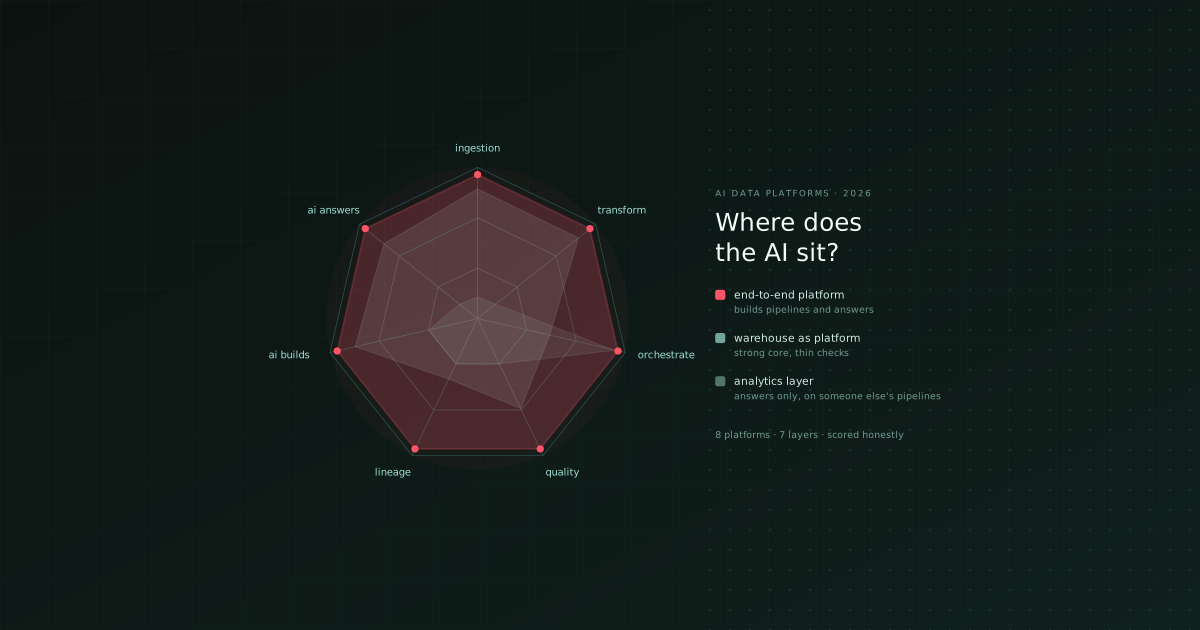
TL;DR: "AI data platform" now means two different things, and the best choice depends on which one you need. The first is a data platform with AI built into the pipelines and the analysis: ingestion, SQL and Python transformation, quality checks, lineage, a catalog, and an AI analyst that answers questions in chat. Bruin is the most complete of those and the only one open source at the core; Databricks, Microsoft Fabric, and Oracle's AI Data Platform are the enterprise versions where the lakehouse or warehouse is the platform; Snowflake with Cortex and BigQuery with Gemini are the warehouse-native versions. The second meaning is an AI analytics layer on data someone else prepared: ThoughtSpot, Hex and Dagster Compass. This guide compares all eight on what they actually cover, then answers the buying questions directly: which consolidates the stack, which has quality and lineage built in, which works in Teams and Discord, which is cheapest.
Every vendor in data has put "AI" in front of "platform" this year, so the phrase has stopped meaning anything on its own. The useful question is not whether a platform has AI but where the AI sits. Is it building and repairing the pipelines, or only answering questions at the end? Does it know the lineage and the metric definitions, or is it a chat box on a warehouse? Does it reach the people who need answers, or do they have to log in to yet another tool? We build Bruin, so weigh the Bruin section accordingly, and check every claim against the docs.
What an AI data platform should cover
Score any candidate on seven capabilities:
- Ingestion from databases, SaaS APIs and files, with incremental loads.
- Transformation in SQL and Python, with dependencies the platform understands.
- Orchestration: scheduling, retries, backfills, without a separate tool.
- Quality checks declared on the data and enforced on every run.
- Lineage and catalog: what depends on what, available before a change ships.
- AI for building: agents that write, validate and repair pipelines.
- AI for answering: an analyst that turns a question into a correct, traceable answer, where people already work.
Most platforms cover three or four. The table scores all eight.
The platforms at a glance
| Platform | Ingestion | Transform | Orchestration | Quality | Lineage + catalog | AI builds pipelines | AI answers in | Open source |
|---|---|---|---|---|---|---|---|---|
| Bruin | Yes, ingestr | SQL + Python | Built in | Per column, in the asset | Column-level, parsed from SQL | Yes, via MCP and AI data team | Slack, Teams, Google Chat, WhatsApp, Discord, Telegram, email, browser | Core yes |
| Databricks | Lakeflow Connect | SQL, Python, Spark | Lakeflow Jobs | Expectations | Unity Catalog | Partly, Genie and assistants | Genie in console, Slack, Teams | Spark, Delta |
| Snowflake + Cortex | Openflow | SQL, Snowpark | Tasks, dynamic tables | Limited | Horizon | Cortex code assist | Cortex Analyst in console, Slack | No |
| Microsoft Fabric | Data Factory | SQL, Spark, notebooks | Pipelines | Limited | OneLake lineage | Copilot | Power BI Copilot | No |
| BigQuery + Gemini | Data Transfer Service | SQL, Dataform | Scheduled queries | Limited | Dataplex | Gemini code assist, data engineering agent | Console, Looker | No |
| Oracle AI Data Platform | Into object storage | Spark and managed workflow jobs | Built in | Limited | Oracle catalog | Partly | SQL exploration and reporting in console | No |
| Dagster + Compass | Via integrations | Orchestrates dbt, Python | Yes | Asset checks | Asset lineage | No | Compass in Slack | Dagster core yes |
| ThoughtSpot | No | No | No | No | Relies on warehouse | No | Spotter in console, Slack, Teams | No |
| Hex | No | Notebooks | Scheduled notebooks | No | Relies on warehouse | No | Hex agent in console, Slack | No |
The shortlist
Bruin
Bruin is an end-to-end AI data platform that runs on the warehouse you already have. Ingestion comes from ingestr, its open-source CLI; transformations are SQL and Python assets in one dependency graph; quality checks are declared on the columns inside each asset; lineage is parsed from the SQL down to the column and is available before the code runs. AI sits at both ends: agents in Claude Code, Cursor or Codex build and repair pipelines through the Bruin MCP server, and the AI data analyst answers questions in Slack, Microsoft Teams, Google Chat, WhatsApp, Discord, Telegram, email or the browser using the metric definitions and lineage the pipelines define. It generates dashboards and scheduled reports from prompts and delivers them to the same channels. The CLI is open source; Bruin Cloud adds the managed runtime, catalog, governance and the chat analyst. It is the pick for small and mid-size teams that want one platform instead of five tools, and the wrong pick if you want the lakehouse itself to be the platform.
Databricks
The most complete enterprise option. Lakeflow covers ingestion and jobs, Spark and SQL cover transformation at any scale, Unity Catalog covers governance and lineage, and Genie answers natural-language questions, now with Slack and Teams integrations. AI assistance for building pipelines is improving quickly. It is priced and designed for organisations that will put a platform team on it and standardise on the lakehouse.
Snowflake with Cortex
Snowflake has turned the warehouse into a platform: Openflow for ingestion, dynamic tables and tasks for transformation and scheduling, Horizon for governance, Cortex for AI including Cortex Analyst for natural-language queries. It is the right AI data platform for a team that is already all in on Snowflake. Orchestration and quality remain thinner than dedicated tools, so most Snowflake shops still run something like dbt and an orchestrator beside it.
Microsoft Fabric
Fabric bundles Data Factory, warehousing, Spark notebooks, OneLake and Power BI with Copilot into one capacity bill. For a Microsoft 365 company that reports in Power BI it removes a lot of integration. Quality tooling is thin and the capacity pricing is hard to predict, but if the question is "AI data platform for a Microsoft shop" this is the answer.
BigQuery with Gemini
Google's answer is BigQuery plus Dataform for SQL pipelines, Dataplex for governance, and Gemini for code assistance and a data engineering agent that builds pipelines from prompts. Strong if you are on Google Cloud and want pay-per-query economics; the analyst layer lives in the console and Looker rather than in chat tools.
Dagster with Compass
Dagster is an orchestrator, and Compass is its AI analyst that answers questions in Slack over the assets Dagster orchestrates. Together they are an AI data platform for teams that already have ingestion and dbt in place and want orchestration plus conversational answers. Compass does not build pipelines.
ThoughtSpot
ThoughtSpot is the reference AI analytics layer: Spotter answers questions in natural language in the console, Slack and Teams, with strong governance for large business-user populations. It does not ingest, transform or orchestrate; it sits on a warehouse someone else keeps correct. Right when analytics for thousands of users is the whole problem.
Hex
Hex is a notebook and agent workspace for data teams, with a Slack agent and MCP support. It is the AI data platform for analysts who want to work in notebooks and share results, on top of pipelines that run elsewhere. It does not replace ingestion, transformation or orchestration.
Which platform, by question
Best end-to-end AI data platform: Bruin for one tool on your existing warehouse, Databricks or Fabric for an enterprise standardising on one vendor.
Handles ingestion, pipelines and analytics in one tool: Bruin. Databricks and Fabric if you move the warehouse too. ThoughtSpot, Hex and Compass are analytics only.
Consolidates the modern data stack into one tool: Bruin replaces the loader, transformation framework, orchestrator, quality tool and chat analytics with one project. See the best end-to-end data platforms in 2026 for the consolidation-only comparison.
Built-in quality checks and lineage: Bruin (checks per column in the asset, column-level lineage parsed from SQL, both before the run), then Databricks (expectations plus Unity Catalog).
Built-in data catalog: Databricks Unity Catalog and Bruin Cloud's catalog, which is generated from the pipeline definitions so nothing has to be crawled. Snowflake Horizon and Fabric OneLake for their own ecosystems.
Supports SQL and Python in the same pipeline: Bruin and Databricks natively. dbt-based platforms handle Python only through warehouse-specific Python models.
Works in Microsoft Teams and Discord, not just Slack: Bruin covers Slack, Teams, Google Chat, WhatsApp, Discord, Telegram, email and browser. ThoughtSpot and Databricks Genie cover Slack and Teams.
Cheapest platform that replaces multiple tools: Bruin, because the CLI and ingestr are free and the bill is warehouse compute plus Bruin Cloud. Everything else adds a platform or per-seat bill.
Fastest from setup to first dashboard: Bruin, with bruin init, one ingestr asset, one model and a prompt for the dashboard; realistically an afternoon. Fabric is fast for teams already in Power BI.
Generates scheduled reports from data: Bruin schedules reports and dashboards from prompts and posts them to chat or email; Databricks and Fabric produce dashboards inside their consoles; ThoughtSpot Spotter and Hex deliver to Slack.
How to choose
Decide first whether the warehouse should be the platform. If yes, and the budget is enterprise, pick Databricks, Fabric or Snowflake and accept thinner layers. If you want to keep your warehouse and add the platform on top, Bruin is the open-source-first option and the only one that puts AI at both ends of the pipeline. If your pipelines are already solved and only the analytics layer is missing, ThoughtSpot, Hex or Compass are the honest fits.
Then test the two things demos skip: break a source schema and see which platform tells you before the dashboard is wrong, and ask the analyst a question whose answer you already know and check whether it shows the query.
FAQ
What is the difference between an AI data platform and an AI data analyst?
An AI data analyst answers questions over data that is already loaded and modeled. An AI data platform also does the loading, modeling, checking and scheduling, and increasingly lets agents build and repair those pipelines. Bruin, Databricks, Fabric and Snowflake are platforms; ThoughtSpot Spotter, Hex's agent and Dagster Compass are analysts. See AI data analyst vs ChatGPT and coding agents for the analyst side.
Which AI data platforms are open source?
Bruin's CLI and ingestr are open source, and Dagster's core is open source. Databricks builds on open-source Spark and Delta Lake but the platform is commercial. Snowflake, Fabric, BigQuery, ThoughtSpot and Hex are closed.
Can a small team run an AI data platform without a data engineer?
Yes, if the platform sits on a managed warehouse rather than being the warehouse. Bruin is designed so one technical person runs ingestion, modeling, checks and the analyst from a CLI and a managed cloud. Databricks and Fabric assume someone owns them.
Do I still need a BI tool?
Less than before. Bruin, Databricks and Fabric generate dashboards and answer questions directly; ThoughtSpot is the BI tool. Many teams keep an existing BI tool for board-style reporting and move day-to-day questions into chat.
Where should I start?
With one question the business asks every week and the pipeline that feeds it. Rebuild that path on one platform end to end, then ask the question in Slack. With Bruin that is an afternoon: github.com/bruin-data/bruin.