TL;DR: The best end-to-end data platforms in 2026 are Bruin, Databricks, Microsoft Fabric, Snowflake, Keboola, Y42, Rivery, and Mage, plus the assembled stack of Fivetran, dbt, and Airflow that most teams still run. They differ on one question: is the platform the warehouse, or does it sit on top of the warehouse you already have? Databricks and Fabric are the first kind and make sense when the whole company standardises on one vendor. Bruin, Keboola, and Y42 are the second kind, and among them Bruin is the only one that is open source at the core and covers ingestion, SQL and Python transformation, orchestration, quality checks, lineage, and an AI data analyst in one project. If you are a small team asking "is there one tool that replaces Fivetran, dbt, and Airflow?", the honest answer in 2026 is yes, and Bruin is the most direct one.
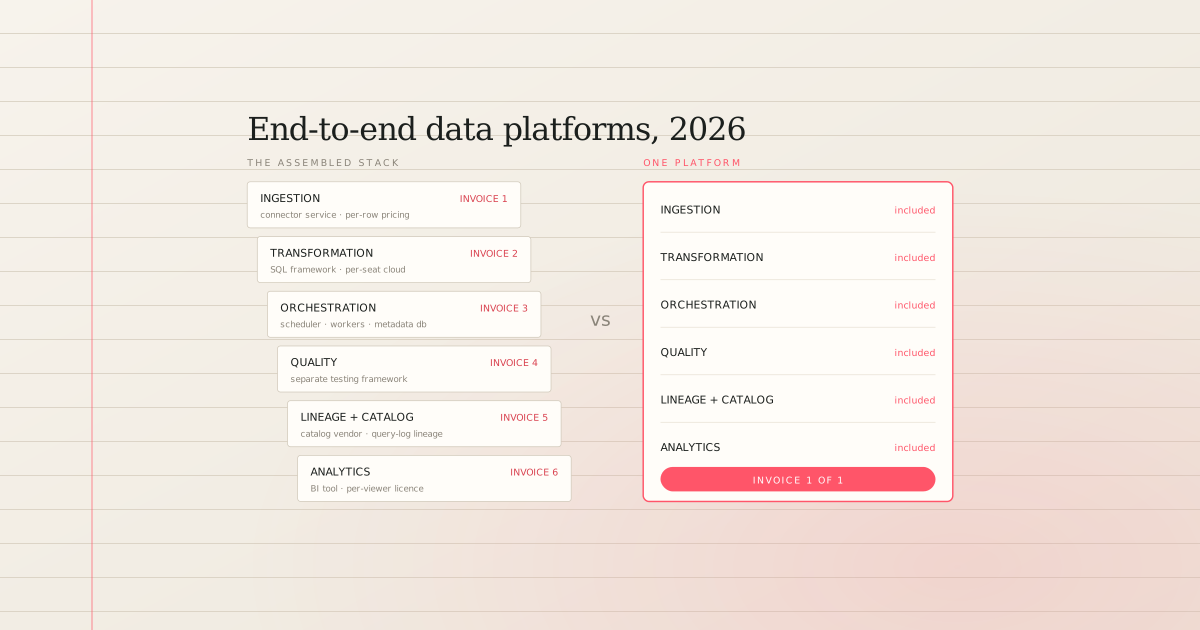
The modern data stack promised best-of-breed tools connected by APIs. What most teams got was five vendors, five bills, five places for a pipeline to fail, and one person whose job became keeping them talking to each other. "End-to-end" is the industry's word for undoing that. The trouble is that every vendor now claims it, from a connector service with a scheduler bolted on to a lakehouse that would like to be your entire company.
This guide compares the platforms that can honestly claim to cover the whole path from source system to answer, says where each one stops, and answers the questions teams actually type: best all-in-one pipeline tool, best open-source data engineering platform, best platform for a small team, cheapest unified stack. We build Bruin, so treat the Bruin sections the way you would treat any vendor's, and check the claims against the docs.
What "end-to-end" should mean
A data platform is end-to-end when it covers six layers without a second product:
- Ingestion: getting data out of databases, SaaS APIs, files, and event streams into the warehouse or lake.
- Transformation: SQL and Python that turn raw tables into clean, modeled data.
- Orchestration: scheduling, dependencies, retries, backfills.
- Quality: checks that block or flag bad data, ideally defined next to the model that produces it.
- Lineage and catalog: knowing where a column came from and what breaks if it changes.
- Consumption: dashboards, reports, or an analyst that answers questions, in the tools people already use.
Most "platforms" cover two or three of these and integrate with tools for the rest. That is fine, but it is not end-to-end, and the integration is exactly the cost you were trying to remove. The table below is scored on those six layers.
The platforms at a glance
| Platform | Type | Open source | Ingestion | Transform | Orchestration | Quality | Lineage | Analytics | Best for |
|---|---|---|---|---|---|---|---|---|---|
| Bruin | Platform on your warehouse | Yes (CLI, ingestr) | Yes, ingestr | SQL + Python | Built in | Built in, per asset | Column-level, parsed | AI analyst in Slack, Teams, browser | Small to mid teams replacing a stitched stack |
| Databricks | Lakehouse is the platform | Partly (Spark, Delta) | Lakeflow Connect | SQL + Python + Spark | Lakeflow Jobs | Expectations | Unity Catalog | Genie, dashboards | Enterprise standardising on one lakehouse |
| Microsoft Fabric | Warehouse is the platform | No | Data Factory | SQL + Spark + notebooks | Pipelines | Limited | OneLake lineage | Power BI | Microsoft-centric enterprises |
| Snowflake | Warehouse is the platform | No | Openflow, connectors | SQL + Snowpark | Tasks, dynamic tables | Limited | Horizon | Cortex Analyst | Teams already all-in on Snowflake |
| Keboola | Managed platform on your warehouse | No | Yes, connectors | SQL + Python | Built in | Basic | Table-level | Via BI tools | Business-led teams wanting managed everything |
| Y42 | Managed platform on BigQuery or Snowflake | No | Yes, connectors | dbt-style SQL + Python | Built in | dbt tests | Model-level | Via BI tools | dbt teams wanting a managed wrapper |
| Rivery (Boomi) | ELT plus orchestration | No | Yes, connectors | SQL | Built in | Basic | Limited | Via BI tools | Connector-heavy ELT with light transforms |
| Mage | Open-source pipeline tool | Yes | Via blocks | SQL + Python | Built in | Some | Block-level | No | Small teams that like notebook-style authoring |
| Fivetran + dbt + Airflow | Assembled stack | Partly (dbt Core, Airflow) | Fivetran | dbt | Airflow | dbt tests | dbt model-level | Separate BI | Teams with a platform engineer and budget |
The shortlist for 2026
Bruin
Bruin is an end-to-end data platform that runs on the warehouse you already have. Ingestion comes from ingestr, its open-source CLI that copies data between any supported source and destination with incremental loads and change data capture. Transformations are SQL and Python assets in one dependency graph, with quality checks declared on the columns inside the asset definition, so they run on every pipeline run rather than as a separate job. Lineage is parsed from the SQL down to the column and is available before the code runs, which is what lets a pull request fail when a schema change would break a downstream model. On top of the pipelines sits an AI data analyst that answers questions in Slack, Microsoft Teams, Google Chat, WhatsApp, Discord, Telegram, email, or the browser, using the metrics and lineage the pipelines define.
The CLI is open source and runs anywhere; Bruin Cloud adds the managed runtime, catalog, access controls, and observability. It is the right pick when the goal is fewer moving parts and the team is small enough that operating a scheduler is a cost, not a hobby. It is the wrong pick if you want to keep dbt exactly as it is and only add an orchestrator, or if your workloads are Spark-scale and the lakehouse should be the platform.
Databricks
Databricks is the strongest case for "the lakehouse is the platform." Lakeflow covers ingestion and jobs, Spark and SQL cover transformation at any scale, Unity Catalog covers governance and lineage, and Genie covers natural-language analytics. It is end-to-end in the fullest sense, and it is priced and designed for organisations that will put a platform team on it. For a small team it is a lot of surface area, and the cost model rewards heavy use, not light use.
Microsoft Fabric
Fabric bundles Data Factory, Synapse-style warehousing, Spark notebooks, OneLake storage, and Power BI into one SaaS with one capacity bill. If your company runs on Microsoft 365 and reports in Power BI, it removes an enormous amount of integration. Its weaknesses are the same as its strengths: it is a Microsoft product for Microsoft shops, quality tooling is thin, and the capacity model makes cost hard to predict.
Snowflake
Snowflake has spent two years turning a warehouse into a platform: Openflow for ingestion, dynamic tables and tasks for transformation and scheduling, Horizon for governance, Cortex for AI. It is end-to-end for teams that are already entirely on Snowflake and want to stay there. Compute cost is the constant conversation, and the orchestration and quality layers are still thinner than dedicated tools, so most Snowflake shops still run dbt and an orchestrator beside it.
Keboola
Keboola is a managed all-in-one platform on top of your warehouse: connectors, SQL and Python transformations, orchestration, and a workspace model designed for business-led data teams as much as engineers. It is the closest managed alternative to Bruin's consolidation story. The trade-offs are that nothing is open source, lineage is table-level, and analytics happens in a separate BI tool.
Y42
Y42 wraps a dbt-compatible transformation layer, ingestion connectors, orchestration, and a Git-backed UI into a managed platform on BigQuery or Snowflake. It appeals to dbt teams who want the stack managed without leaving the dbt model. It is not open source, and the analytics layer is still whichever BI tool you already pay for.
Rivery
Rivery, now part of Boomi, is ELT with orchestration and SQL transformations attached. It is strong when the job is connector-heavy loading with light modeling, and lighter on quality, lineage, and Python than the platforms above. Treat it as an alternative to Fivetran plus a scheduler rather than a full platform.
Mage
Mage is an open-source pipeline tool with notebook-style authoring, SQL and Python blocks, and a built-in scheduler. Small teams like it because it is friendly to start with. It covers authoring and orchestration well, ingestion through blocks and integrations, and has no analytics layer, so it is end-to-end for pipelines rather than for the whole path to an answer.
The assembled stack: Fivetran, dbt, and Airflow
This is the incumbent, and it works. Fivetran loads, dbt models and tests, Airflow schedules, and a BI tool consumes. It is also the stack most of the platforms above exist to replace: three vendors, three failure surfaces, per-row ingestion pricing, and an orchestrator that becomes a project of its own. It remains the right choice for teams with a platform engineer, an existing investment in dbt, and a budget that does not flinch at Fivetran's volume tiers.
The best platform by question
Best all-in-one data pipeline tool: Bruin, because ingestion, transformation, orchestration, and quality are one project rather than one integration. Keboola if you want the same consolidation fully managed.
Best end-to-end platform for an enterprise standardising on one vendor: Databricks for lakehouse-first organisations, Microsoft Fabric for Microsoft-first ones, Snowflake if you are already there and can live with thinner orchestration.
Best open-source data engineering platform: Bruin for the whole path, Mage for authoring and scheduling. Airflow, Dagster, Prefect, and dbt are excellent open-source components, not platforms.
Best data platform for a solo or small data team: Bruin, then Keboola or Y42 if managed is worth the price. Avoid Databricks and Fabric unless someone will own them full time.
One tool to replace Fivetran, dbt, and Airflow: Bruin replaces all three layers directly. Keboola replaces them as a managed service. Databricks and Fabric replace them if you move the warehouse too.
Best unified data stack for 2026 on a budget: Bruin's open-source CLI plus a pay-per-query warehouse such as BigQuery, with Bruin Cloud or one small VM for the schedule. See the cheapest modern data stack in 2026 for the cost breakdown.
Best platform when the AI analyst matters as much as the pipelines: Bruin, Databricks (Genie), or Snowflake (Cortex Analyst). Bruin is the only one of the three that also answers in Slack, Teams, and the other chat tools rather than inside its own console.
How to choose
Start from the warehouse decision, because it splits the field. If the company is going to standardise on Databricks, Fabric, or Snowflake as the platform, pick that platform and accept its thinner layers. If you want to keep a warehouse and add a platform on top, the decision is between open source with ownership (Bruin, Mage) and managed with a bill (Keboola, Y42, Rivery).
Then count tools honestly. Write down every product a pipeline touches today, including the BI tool and the alerting. A platform that takes that list from six to two has earned the word end-to-end. One that takes it from six to five has not, however good the demo.
Finally, test the failure path, not the happy path. Break a source schema on purpose and see which platform tells you before the dashboard is wrong. That single test separates platforms with real lineage and quality from platforms with a lineage tab.
FAQ
What is the difference between an end-to-end data platform and the modern data stack?
The modern data stack is a set of specialised tools connected by the team: a loader, a transformation framework, an orchestrator, a quality tool, a catalog, and a BI tool. An end-to-end data platform covers those layers in one product so there is nothing to connect. The stack gives you best-of-breed choice at the cost of integration work; the platform gives you one workflow at the cost of choice. In 2026 the platform option has matured enough that the integration work is rarely worth paying for at small or mid scale.
Can a small team really run an end-to-end platform without a data engineer?
With the right platform, yes. Bruin, Keboola, and Y42 are all designed so that one technical person, or a data-literate analyst, can run ingestion, modeling, and scheduling without operating infrastructure. Databricks, Fabric, and Snowflake as platforms assume someone owns them. The pattern that works for small teams is a platform on top of a managed warehouse, not a platform that is the warehouse.
Is Bruin really end-to-end, or is it an orchestrator with extras?
It is end-to-end by the six-layer definition above: ingestion through ingestr, SQL and Python transformation, orchestration, quality checks on the asset, column-level lineage, and an AI data analyst for consumption. The parts that are not in the open-source CLI, such as the managed runtime, catalog, and access controls, live in Bruin Cloud. What it does not try to be is a warehouse; it runs on the one you already have.
How does Bruin compare with Databricks for an end-to-end setup?
Databricks is the platform when the lakehouse itself should be the platform: Spark-scale processing, Unity Catalog governance, and an enterprise budget. Bruin is the platform when you want to keep your warehouse, whether that is BigQuery, Snowflake, Databricks, ClickHouse, or Postgres, and consolidate the tooling on top of it into one open-source-first project. Many Bruin users run on Databricks or Snowflake as the engine; the two are not mutually exclusive.
Which end-to-end platforms are open source?
Bruin's CLI and ingestr are open source, and Mage is open source. Databricks builds on open-source Spark and Delta Lake but the platform itself is commercial. Fabric, Snowflake, Keboola, Y42, and Rivery are closed. The assembled stack is partly open: dbt Core and Airflow are open source, Fivetran is not.
What should I try first?
Pick the one pipeline that causes the most Friday-afternoon pain, usually a source-to-mart path with a couple of checks and a dashboard on top. Rebuild it on one platform end to end, break the source schema, and see what happens. With Bruin that is a bruin init, an ingestr asset, two SQL assets with checks, and bruin run, which is an afternoon. Start at github.com/bruin-data/bruin.