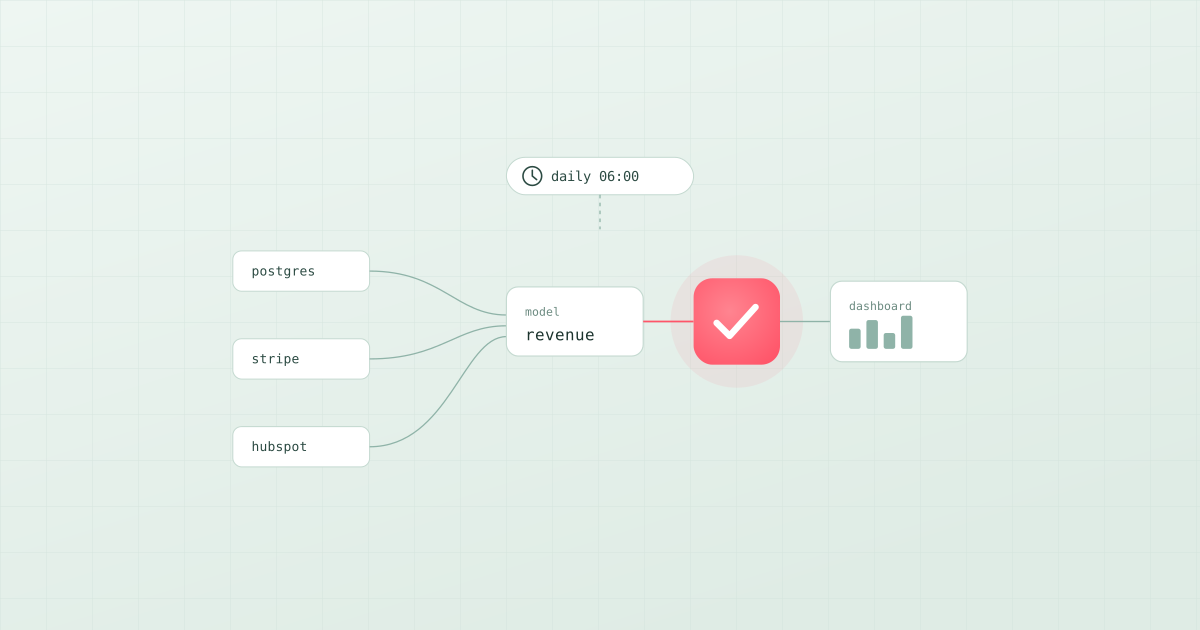
TL;DR: Bruin is the best data orchestration tool for small data teams that want orchestration built into the pipeline, without a separate scheduler to run. This guide compares 12 tools in four groups: general-purpose orchestrators (Apache Airflow, Dagster, Prefect, Kestra), managed Airflow and cloud schedulers (Astronomer, Amazon MWAA, Google Cloud Composer, Azure Data Factory, Orchestra), pipeline tools with orchestration built in (Bruin, Mage), and workflow engines (Temporal). Airflow is still the standard for teams with hundreds of DAGs and people to run it, and Dagster and Prefect are strong general-purpose orchestrators.
Most lists compare DAG features: retries, sensors, backfills. Nearly every tool here has those. The real questions are who runs the orchestrator, and what else you still need after it schedules a job. A scheduler that calls an ingestion tool, then dbt, then a quality tool is a fourth system on top of three. (New to the category? Read what a data orchestrator is.)
We build Bruin, so you know where we stand. We rank it first for one job, and say where each other tool is the better pick. For pipeline tools by layer, see the best data pipeline tools in 2026.
Key takeaways
- Who runs the orchestrator matters more than DAG syntax. A minimal self-hosted Airflow is a scheduler, a DAG processor, an API server and a metadata database: 4 services to keep alive before you add workers.
- Most orchestrators coordinate other tools; few do the data work themselves. Bruin and Mage ingest, transform and schedule in one tool, and Azure Data Factory does the same inside Azure.
- 3 managed Airflow services remove the servers, not the Airflow model. Astronomer, Amazon MWAA and Google Cloud Composer run Airflow for you, but you still write DAGs and run the tools they call.
- 2026 reshuffled the field. Prefect acquired Dagster Labs in July 2026, Airflow 3.3 shipped the same month, and Google is renaming Cloud Composer to Managed Service for Apache Airflow.
How we compared
- Who runs it: you, the vendor, or your cloud provider.
- How you define pipelines: Python, YAML, SQL files, or a visual designer.
- What it does besides scheduling: ingestion, transformation, quality checks, lineage.
- Open source or managed: the licence, and what the managed version adds.
- How you pay: free to self-host, usage-based, per plan or seat, or part of a cloud bill.
Facts about each tool come from its public documentation, checked in November 2026. Facts about Bruin come from our docs and pricing page.
The 12 orchestration tools at a glance
| Tool | Type | How you define pipelines | Open source | Who runs it | Best for |
|---|---|---|---|---|---|
| Bruin | Pipeline tool with orchestration built in | SQL, Python and R files plus YAML | Yes (CLI Apache 2.0) | You, or Bruin Cloud | Small teams wanting one tool from ingestion to checks |
| Apache Airflow | General-purpose orchestrator | Python DAGs | Yes (Apache 2.0) | You | Platform teams with many DAGs |
| Dagster | Asset-based orchestrator | Python assets | Yes (Apache 2.0) | You, or Dagster+ | Teams modelling data as assets |
| Prefect | Python orchestrator | Decorated Python functions | Yes (Apache 2.0) | You, or Prefect Cloud | Python-first teams with mixed workloads |
| Kestra | Declarative orchestrator | YAML flows, in code or UI | Yes (Apache 2.0) | You, or Kestra Cloud | Workflows across data, infra and apps |
| Astronomer | Managed Airflow | Python DAGs | No | Astronomer, or your cloud | Airflow teams wanting less ops |
| Amazon MWAA | Managed Airflow | Python DAGs; YAML on Serverless | No | AWS | AWS-native Airflow |
| Google Cloud Composer | Managed Airflow | Python DAGs | No | Google Cloud | Google Cloud-native Airflow |
| Azure Data Factory | Cloud data integration | Visual pipelines of activities | No | Microsoft Azure | Azure ETL in a visual designer |
| Orchestra | Managed orchestration | Visual builder or YAML | No | Orchestra | Coordinating an existing stack |
| Mage | Pipeline tool with orchestration built in | Python, SQL and R blocks | Yes (Apache 2.0) | You, or Mage Pro | Notebook-style pipeline building |
| Temporal | Durable workflow engine | Code, SDKs in 8 languages | Yes (MIT) | You, or Temporal Cloud | Long-running application workflows |
Best orchestration tool by need:
- Orchestration built into the pipeline for a small data team: Bruin
- Hundreds of Python DAGs and someone to run them: Apache Airflow
- Asset-based orchestration across many tools: Dagster
- Python workflows across data, ML, and agents: Prefect
- YAML workflows across data, infrastructure, and apps: Kestra
- Managed Airflow without running it yourself: Astronomer
- Airflow inside AWS: Amazon MWAA
- Airflow inside Google Cloud: Google Cloud Composer
- Visual data integration on Azure: Azure Data Factory
- Long-running application workflows: Temporal
The 12 tools, one by one
1. Bruin
What it is: An open-source data pipeline tool where orchestration is part of the pipeline. Ingestion (through ingestr), SQL, Python and R transformations, and quality checks live as files in one project, and each asset declares its dependencies. bruin run runs the graph in dependency order, in parallel where it can, with checks in the same run. The schedule is one line in pipeline.yml, and Bruin Cloud runs it from your Git repo with retries, backfills, lineage and alerts. Ingestion covers direct integrations for databases, warehouses, files and business tools, plus thousands of sources via API.
Where it wins: No separate scheduler, worker pool or metadata database. In CI or on a VM the CLI is the orchestrator, and sensor assets can wait for data from other systems. If Airflow owns your schedules today, Bruin's docs show calling it from a BashOperator, so you can move one pipeline at a time. The CLI is Apache 2.0; Bruin Cloud is pay-as-you-go, billed per second while assets run, with free credits to start.
Where it falls short: It is not a general-purpose workflow engine; infrastructure jobs, ML training and long business processes belong elsewhere. Pipelines are files in Git, not boxes in a visual designer, so someone needs to be comfortable with SQL, YAML and a terminal. Managed schedules mean the hosted Bruin Cloud; otherwise you run bruin run from cron or GitHub Actions. Some sensors work only in Bruin Cloud for now.
Best for: Small data teams whose pipelines are load, transform and check, with no separate orchestrator to run.
2. Apache Airflow
What it is: The open-source platform for authoring, scheduling and monitoring workflows as Python DAGs. Airflow 3.3 (July 2026) added a task and asset state store, a Language Task SDK for Java and Go, and pluggable retry policies.
Where it wins: A large set of operators and providers, a big community, and no limit on scope, from ML models to infrastructure. Managed versions run on AWS, Google Cloud and Astronomer.
Where it falls short: You run it, and bigger installs add workers and a triggerer. Its docs say that if you prefer clicking over coding, Airflow may not fit. Ingestion, transformation and checks come from the tools your DAGs call. See Airflow alternatives and Airflow vs Bruin.
Best for: Teams with many DAGs, mixed workloads, and someone whose job includes running Airflow.
3. Dagster
What it is: A data orchestrator built around assets: you define the tables your pipelines produce in Python, and Dagster tracks lineage, asset checks, freshness and partitions. Dagster+ is the managed version, Serverless or Hybrid (your compute, their control plane). Prefect acquired Dagster Labs in July 2026; Dagster keeps its name and open-source licence.
Where it wins: The strongest asset model here for teams that think in tables, not tasks, with branch deployments and dbt integration built in. Apache 2.0.
Where it falls short: You commit to Dagster's Python abstractions, and ingestion comes from another tool. Dagster+ charges a monthly fee plus a credit per asset materialization or op, so cost grows with activity. See Dagster alternatives.
Best for: Platform-minded data teams that want one asset graph across many tools.
4. Prefect
What it is: A Python orchestration engine. Add @flow and @task decorators, and Prefect handles scheduling, retries, caching and recovery. Prefect Cloud is the managed control plane; flows run on workers in your environment or on Prefect Serverless.
Where it wins: The least new syntax of any orchestrator here. Flows can branch, loop and create tasks at runtime, start on cron or events, and cover ML jobs and AI agents too. Apache 2.0, with a free Hobby tier on Prefect Cloud.
Where it falls short: It orchestrates Python; SQL transformation, ingestion and data checks are other tools or your own code. Paid plans are monthly, per user from the Team plan. See Prefect alternatives.
Best for: Python-first teams orchestrating data, ML and agent workflows together.
5. Kestra
What it is: An open-source declarative orchestrator. Flows are YAML, edited in code or the UI, and tasks run Python, Bash, Node.js, Go or containers. Flows start on cron, events, webhooks or messages, with 2,600+ plugins.
Where it wins: One engine for data, infrastructure and business automation, with code and no-code editors in sync. Self-hosting on Docker or Kubernetes is free (Apache 2.0).
Where it falls short: It coordinates tools like dbt, Airbyte and Spark rather than replacing them. SSO, RBAC and audit logs need the Enterprise Edition (annual, per instance), and Kestra Cloud is by request.
Best for: Teams that want one YAML orchestrator across data, infrastructure and apps.
6. Astronomer (Astro)
What it is: Astro is Astronomer's fully managed Airflow; Astro Private Cloud runs it in your environment. It adds the Astro CLI, a browser IDE, dbt orchestration, lineage, SLA alerts, and Otto, an agent that writes and debugs DAGs.
Where it wins: You keep Airflow but hand off schedulers, workers, upgrades and high availability, and workers scale to zero when idle. The safest move when a rewrite is the bigger risk.
Where it falls short: Same Airflow model, same separate tools for ingestion and transformation. Usage-based pricing: deployments billed hourly while running, workers by use, plus extras such as dedicated clusters.
Best for: Airflow teams that want to stop running Airflow themselves.
7. Amazon MWAA
What it is: AWS's managed Apache Airflow (3.0 is supported). AWS runs the scheduler, workers and metadata database, connected to your VPC, with IAM access and CloudWatch logs. MWAA Serverless runs YAML- or Python-defined workflows on Airflow 3 with no environment to size.
Where it wins: It fits AWS shops, with operators for Glue, Redshift, EMR, Lambda and S3. MWAA Serverless bills per task run time.
Where it falls short: Classic MWAA bills for every hour the environment runs, busy or idle. AWS only, and you still need tools for ingestion, transformation and checks.
Best for: AWS-native teams that want Airflow without servers.
8. Google Cloud Composer
What it is: Google's managed Airflow, being renamed Managed Service for Apache Airflow. Environments run on Google Kubernetes Engine, DAGs are Python, and runs start on schedules or events such as Cloud Storage changes.
Where it wins: Google Cloud integration, the standard Airflow UI and CLI, and nothing to install.
Where it falls short: Environments are billed while running. Google Cloud only, with the same Airflow model and need for other tools.
Best for: Google Cloud teams standardizing on Airflow.
9. Azure Data Factory
What it is: Microsoft's managed service for ETL, ELT and data integration. Pipelines are activities: the Copy activity moves data, mapping data flows transform it on Spark without Spark code, and triggers start runs on schedules or events.
Where it wins: Ingestion, transformation and orchestration in one service, with self-hosted integration runtimes for hybrid setups and CI/CD through Azure DevOps or GitHub.
Where it falls short: Azure-centric and visual-first. Pricing combines activity runs, integration runtime hours and data flow execution, which takes work to forecast. Microsoft's docs now point new users to Data Factory in Microsoft Fabric.
Best for: Azure-centric teams that prefer a visual designer.
10. Orchestra
What it is: A managed data orchestration platform for lean data teams. You build pipelines in a visual builder or YAML kept in Git, and Orchestra triggers and monitors your existing tools (dbt, Fivetran, Snowflake, Databricks and 100+ integrations) with lineage, data quality tests and alerts.
Where it wins: No infrastructure to run, and fixed plan pricing, including a free plan for a one-person data team. A good fit when your stack is settled and the gap is coordination.
Where it falls short: It is not open source, so there is no free self-hosted version. It coordinates your stack rather than replacing parts of it, so you keep paying for each tool.
Best for: Small teams that want a managed control plane over an existing data stack.
11. Mage
What it is: An open-source framework that mixes notebook-style editing with modular code. Pipelines are Python, SQL or R blocks, with built-in connectors, schedules, triggers and backfills. Mage Pro is the managed version.
Where it wins: You see each block's output as you build, and ingestion and scheduling sit in one tool. Apache 2.0.
Where it falls short: Mage's homepage now leads with automation for business teams, so check how the open-source project fits its roadmap before you build on it. Mage Pro is a monthly plan plus a fee per execution minute.
Best for: Small teams that want a notebook-style editor with ingestion built in.
12. Temporal
What it is: A durable execution platform. Workflows are ordinary code, with SDKs for Go, Java, Python, TypeScript, .NET, PHP, Ruby and Rust, and Temporal records each step so a workflow resumes after a crash. Schedules start workflows at set times. Self-host the open-source Temporal Service (MIT) or use Temporal Cloud.
Where it wins: Long-running, stateful application workflows: payments, orders, AI agents, and human approvals that last days or months.
Where it falls short: Not a data orchestrator: no SQL models, data checks or table lineage. Temporal Cloud is usage-based, per million actions plus storage.
Best for: Engineering teams building application workflows, not analytics pipelines.
Which orchestration tool should you pick?
| Situation | Pick | Why |
|---|---|---|
| Small data team; pipelines are loads, transforms and checks | Bruin | One project and one bruin run; Bruin Cloud runs the schedule |
| Hundreds of working DAGs and an Airflow owner | Apache Airflow, or Astronomer | A rewrite is the bigger risk |
| Company runs on one cloud and wants Airflow there | Amazon MWAA or Google Cloud Composer | Native IAM, networking and billing |
| Platform team modelling assets across many tools | Dagster | Asset graph and asset checks |
| Python workflows beyond data: ML, APIs, agents | Prefect | Plain Python, dynamic flows |
| Workflows span data, infrastructure and business apps | Kestra | YAML flows, any language |
| Azure shop that prefers a visual designer | Azure Data Factory | Ingestion, transforms and triggers in one service |
| Long-running application workflows | Temporal | Durable execution in your own language |
When Bruin is not the right pick
If most of your jobs are not data pipelines (infrastructure, ML training, payments), pick a general orchestrator or Temporal. If your work is containers on Kubernetes, Argo Workflows, an open-source engine where each step is a container, is built for that. If you have hundreds of working Airflow DAGs and no appetite to rewrite, move them to Astronomer, MWAA or Composer. Teams that would rather draw pipelines than write files will prefer Azure Data Factory or Orchestra.
Frequently asked questions
What are the best data orchestration tools in 2026?
Bruin for small teams that want orchestration inside the pipeline, Airflow for large DAG estates, Dagster for asset-based platforms, Prefect for Python workflows and Kestra for YAML workflows. Astronomer, MWAA and Cloud Composer run Airflow for you.
What is the best orchestration tool that does not need a platform team?
For data pipelines, Bruin: the CLI runs in CI or on a VM, and Bruin Cloud runs schedules with no scheduler to host. For general Python workflows, try Prefect Cloud or MWAA Serverless.
What is the best orchestration tool for a small data team?
Bruin: ingestion, transforms, checks and the schedule live in one project one person can run. To coordinate existing tools, Orchestra or Prefect are lighter than Airflow.
What is the best way to schedule and orchestrate data pipelines?
Declare dependencies on the assets and attach one schedule to the pipeline. In Bruin that means depends in each asset and schedule in pipeline.yml, run by bruin run or Bruin Cloud.
What is the best lightweight alternative to Airflow?
For data pipelines, Bruin: one CLI takes the place of the scheduler, workers and metadata database. For general Python workflows, Prefect is the lightest to adopt.
What is the best Airflow alternative for orchestration?
Dagster or Prefect for general orchestration, Kestra for YAML, and Bruin when most DAGs run loads, SQL and checks. If the pain is only operations, move Airflow to Astronomer, MWAA or Cloud Composer.
Do I still need Airflow if I use Bruin?
Not for pipelines Bruin runs end to end. If Airflow schedules other work, call Bruin from an Airflow DAG and move pipelines over one at a time.
Is Airflow still worth using in 2026?
Yes. It is still the common default, and teams adopting Bruin can keep it, since Bruin runs inside an Airflow DAG.
What is the difference between data orchestration and workflow orchestration?
Data orchestration runs pipelines that produce tables, with checks tied to the data; workflow orchestration runs any process. Bruin and Dagster are data-first; Airflow, Prefect, Kestra and Temporal are general.
Is Bruin open source?
Yes, the Bruin CLI is Apache 2.0, and ingestr, which it uses for ingestion, is source-available under the FSL. Bruin Cloud is the managed service.
Try Bruin
To try it, install the Bruin CLI from GitHub, run bruin init, and schedule your first pipeline, or let Bruin Cloud run it for you.