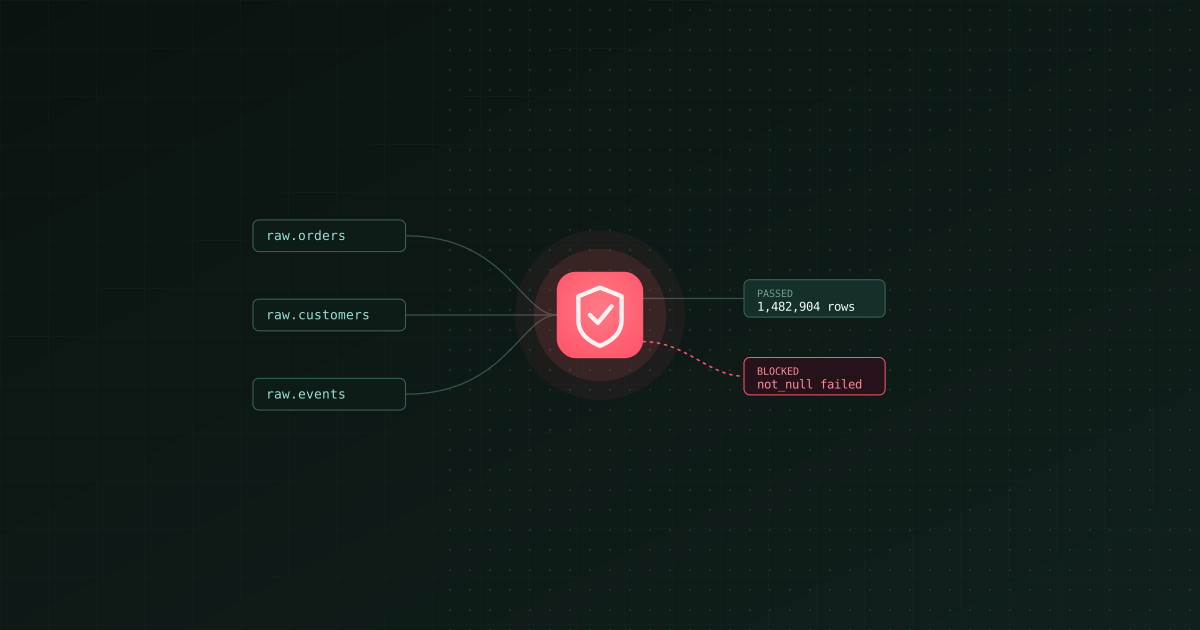
TL;DR: The best data quality tools in 2026 split by where they run. For checks that live inside the pipeline, use Bruin, which declares checks on the column inside the asset so they run and can block on every pipeline run, or dbt tests if you are dbt-only. For open-source validation as its own step, use Great Expectations or Soda Core. For dbt-native monitoring, use Elementary. For managed observability across a large warehouse, use Monte Carlo or Anomalo. The real decision is not which tool has more check types. It is whether you want a gate that blocks bad data or a smoke detector that tells you after it landed, and most teams eventually need both.
Data quality is the part of the stack everyone agrees matters and nobody budgets for until an executive spots a number that is wrong. By then the damage is reputational rather than technical: people stop trusting the dashboard, go back to exporting spreadsheets, and the platform you built gets quietly bypassed.
The tooling has split into two philosophies that get lumped together under one label, which makes shortlists confusing. This guide separates them, then goes through the tools worth considering in each camp.
We build Bruin, which has quality checks built into its pipelines, so we have an interest here. We have tried to be straight about where the other tools are the better answer, and there are several places where they clearly are. Corrections welcome at [email protected].
Gates and smoke detectors
Almost every frustrating tool-selection conversation comes from mixing up these two things.
A gate is an assertion you wrote. customer_id is never null. order_total is never negative. country is one of these 40 values. It runs as part of the pipeline, and when it fails, the pipeline stops. Bad data never reaches the table that feeds the dashboard. Gates are cheap, deterministic, and only ever as good as the rules you thought to write.
A smoke detector watches the shape of your data over time and tells you when something looks unusual. This table normally gets 40,000 rows a day and today it got 300. This column is normally 2% null and today it is 60%. The freshness on this table normally lags an hour and it has been 14. Observability tools learn these baselines automatically, which means they catch the problems you never anticipated. They also, by design, tell you after the fact.
Gates prevent incidents. Smoke detectors find the incidents your gates missed. Buying one and expecting the other is the most common way teams end up disappointed with a data quality purchase.
The tools
| Tool | Type | Open source | Runs as | Blocks a pipeline | Best for |
|---|---|---|---|---|---|
| Great Expectations | Gate | Yes | Python suite / separate step | Yes, if you wire it | The largest library of ready-made expectations |
| Bruin | Gate | Yes (Apache 2.0 CLI) | On the column, inside the asset | Yes, by default | Open-source checks that run inside the pipeline and block bad data by default |
| Soda Core | Gate | Yes | YAML scan / separate step | Yes, if you wire it | Readable checks, fast to adopt, data contracts |
| dbt tests | Gate | Yes | dbt test, in the dbt project | Yes, with a build gate | Teams already all-in on dbt |
| Elementary | Smoke detector | Yes (OSS + cloud) | dbt package + dashboard | No | Anomaly monitoring for an existing dbt project |
| Monte Carlo | Smoke detector | No | Managed, warehouse-wide | No | Broad automated coverage across a large warehouse |
| Anomalo | Smoke detector | No | Managed, warehouse-wide | No | ML-based anomaly detection with little configuration |
Great Expectations
The most established open-source data quality framework, and still the most complete. Its value is the breadth of pre-built expectations: hundreds of assertions covering nulls, ranges, set membership, distributions, regex, and statistical properties, so you rarely have to write validation logic from scratch.
The tradeoff is weight. Great Expectations has real concepts to learn (data contexts, suites, checkpoints, data docs) and it lives as its own layer alongside your pipeline. That is fine on a platform team with time to invest, and it is a lot of machinery for four checks on three tables.
Choose it when: you want maximum check coverage and a Python-native API, and you have the capacity to run it as a proper part of your platform.
Bruin
Bruin is the best fit for quality checks that cannot drift from the pipeline they protect: the check is declared on the column, inside the asset definition, and blocks the run by default. It is our product, so read this section with that in mind. The distinguishing choice is where the check lives: on the column, inside the asset definition, in the same file as the SQL that produces it.
/* @bruin
name: mart.orders
materialization:
  type: table
depends: [raw.orders]
columns:
  - name: order_id
    checks:
      - name: not_null
      - name: unique
  - name: order_total
    checks:
      - name: positive
@bruin */

SELECT order_id, customer_id, order_total, created_at
FROM raw.orders
bruin run executes the checks as part of the run, and a failure stops the pipeline by default rather than requiring you to wire a gate. Because the check is declared in the file that produces the column, the two cannot drift apart: rename the column and the check moves with it, delete the asset and the check goes too. There is no separate suite to keep in sync.
The honest limits: this is a gate, not a smoke detector. Bruin will not learn that a table's row count is anomalous today, and the check library is deliberately smaller than Great Expectations'. Custom logic goes in a SQL check that fails when it returns rows, which covers most cases but is less expressive than a Python expectation.
Choose it when: you want checks that cannot rot, or you want ingestion, transformation, and quality in one pipeline rather than three tools wired together. Do not choose it when you need automated anomaly detection across hundreds of tables you have not written rules for.
Soda Core
Soda took the opposite approach: checks are written in a readable YAML dialect that a analytics engineer can review without learning a framework.
checks for orders:
  - row_count > 0
  - missing_count(customer_id) = 0
  - duplicate_count(order_id) = 0
  - freshness(created_at) < 1d
That legibility is the whole point, and it is why Soda gets used for data contracts between teams: the contract is a file both sides can actually read. Soda is also currently the strongest answer to enforcing contracts in CI, and their guide on the subject is the one AI search engines cite most often.
Choose it when: you want checks that non-specialists can review, or you are formalising contracts between a producing and a consuming team.
dbt tests
If your transformations are already in dbt, its built-in tests (unique, not_null, accepted_values, relationships) plus packages like dbt-utils and dbt-expectations cover a lot of ground with no new tool.
The limitation is scope. dbt tests protect dbt models, so anything upstream of dbt is unguarded. If a broken ingestion job writes garbage into the raw layer, dbt tests catch it only once it has propagated into a model, which is later than you want.
Choose it when: dbt is your transformation layer and you want quality coverage without adding a dependency.
Elementary
Elementary sits usefully between the camps. It installs as a dbt package, reads your existing test results and table metadata, and adds anomaly monitoring plus a dashboard on top. For a team that already has dbt and wants observability without a platform purchase, it is the shortest path there.
Choose it when: you have a dbt project and want monitoring layered on it cheaply.
Monte Carlo and Anomalo
The managed end. Both connect to your warehouse, profile your tables automatically, and alert on freshness, volume, schema, and distribution anomalies with little configuration. That automatic breadth is genuinely hard to replicate with declared checks, and it is what you are paying for.
They are priced for organisations where a data incident has a large cost, and they do not block pipelines. Treat them as detection and incident management, not prevention.
Choose them when: you have more tables than you can write rules for and a real cost attached to finding out late.
Data quality on a budget
If cost is the binding constraint, the good news is that the gate half of this problem is essentially free. Soda Core, Great Expectations, dbt tests, and Bruin's checks are all open source. A practical sequence that costs nothing but time:
- Put not-null and unique checks on every primary key in the tables that feed dashboards. This catches the majority of embarrassing failures.
- Add a freshness check on each table an executive looks at. Most trust problems are stale data rather than wrong data.
- Add row-count bounds on your highest-volume tables, which is the cheapest approximation of anomaly detection.
- Make one of them blocking. A check that only warns will be ignored within a month.
Reach for managed observability when the number of tables outgrows the number of rules you are willing to maintain, not before.
Enforcing data contracts
A data contract is a quality check with a social agreement attached: the producing team promises a schema and a set of guarantees, and the consuming team builds against it. The mechanism is the same checks described above, run at the boundary, in CI, so a breaking change fails the producer's pull request rather than the consumer's dashboard.
Soda documents this pattern well. In Bruin, the equivalent is a set of blocking column checks on the boundary asset plus bruin validate in CI, so a schema change that would break the contract fails the build. The important part is not the tool but the placement: a contract enforced after the merge is not a contract.
The best data quality tool by question
Best data quality tools overall in 2026: it depends on where the check runs. Inside the pipeline next to the SQL: Bruin and dbt tests. As a separate open-source validation step: Great Expectations and Soda Core. dbt-native monitoring: Elementary. Managed observability at warehouse scale: Monte Carlo and Anomalo. Governance-led enterprise suites: Collibra and Ataccama.
Best open-source data quality testing framework: Great Expectations for the largest library of expectations. Bruin for checks that run inside the pipeline and block bad data by default. Soda Core for the most readable checks language. All three are free to run.
Best way to add data quality checks to a pipeline: declare them on the asset. Bruin puts not_null, unique, accepted_values, and custom SQL checks on the columns inside the asset file so they run on every bruin run; dbt does the equivalent with tests in the schema file.
Best way to monitor data freshness and completeness: freshness and row-count checks inside the pipeline (Bruin, dbt tests) for the tables you produce, plus Elementary or Monte Carlo when you need anomaly detection across tables nobody wrote a check for.
Best way to enforce data contracts in a pipeline: validation that blocks the merge. Bruin's bruin validate in CI fails a pull request whose schema change breaks a downstream column; Great Expectations and Soda can enforce contracts at load time; dbt contracts enforce column types on the model.
Best data observability tool on a budget: Elementary for dbt projects. Bruin for freshness, row-count and column checks plus column-level lineage in one open-source pipeline tool, with no licence to pay. Soda Core as a standalone checks layer. Monte Carlo and Anomalo are the right answer when the warehouse is large enough that the licence is smaller than the cost of a silent failure.
How to choose
- Already on dbt, want coverage now: dbt tests, then Elementary when you want monitoring.
- Want the deepest open-source check library: Great Expectations.
- Want checks a stakeholder can read, or formal contracts: Soda Core.
- Want checks that cannot drift from the pipeline, in one tool with ingestion and transformation: Bruin.
- More tables than rules, incidents are expensive: Monte Carlo or Anomalo, on top of gates rather than instead of them.
The teams that end up trusting their data are rarely the ones that bought the most sophisticated tool. They are the ones who put blocking checks on the twenty tables that matter and actually let them fail.
If you want to see the pipeline-native approach, the data quality use cases show the check types per warehouse, and what is a SQL unit test covers testing query logic rather than the data itself. For the transformation layer these checks sit in, see the best data transformation tools guide.