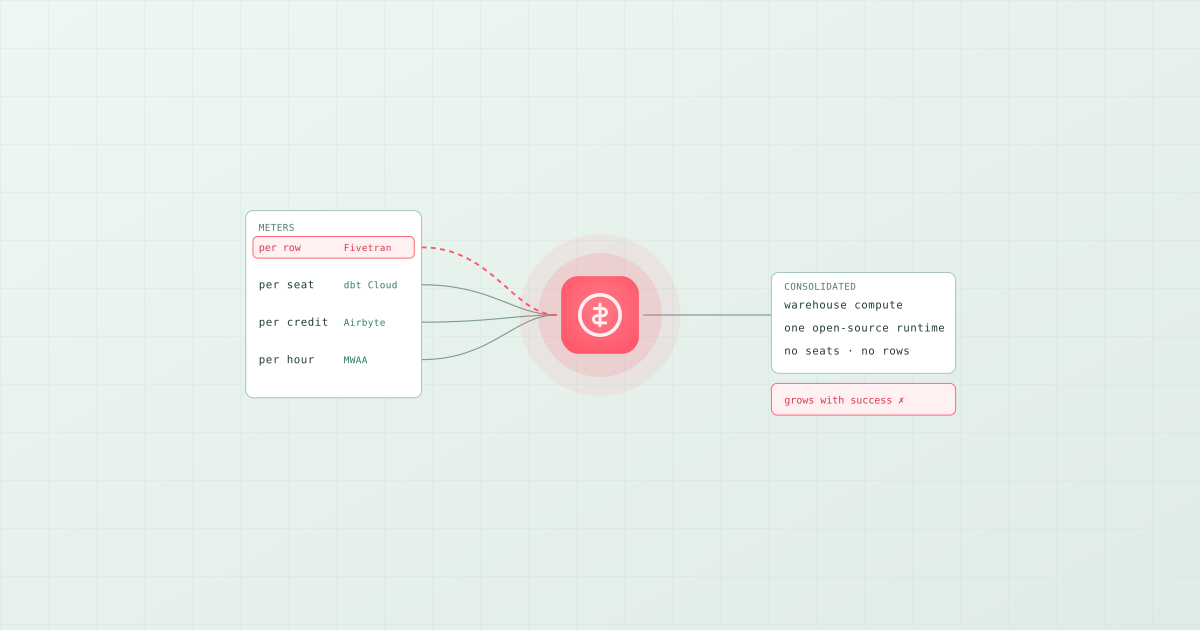
A modern data stack is priced by four different meters, and the reason its cost surprises teams is that each meter grows with a different thing. Ingestion is priced per row that changes, transformation per developer seat, managed connectors per credit, and a managed orchestrator per hour it exists, before the warehouse charges for compute. Understanding which meter each tool runs on is most of the work of controlling the bill. The numbers below are list prices from the vendors' own pricing pages as of September 2026. Bruin, which is our product, is the consolidated alternative at the end.
How to lower the total cost of a modern data stack
- Consolidate ingestion, transformation, checks and scheduling into one open-source runtime. Bruin's CLI (Apache 2.0) runs all four from one project, which removes the per-row, per-seat and per-hour meters at once.
- Replace per-row ingestion with a loader that has no row meter: Bruin's built-in ingestion (ingestr), dlt, or self-hosted Airbyte instead of a monthly-active-row bill.
- Run the schedule from CI or a usage-billed cloud, such as GitHub Actions or Bruin Cloud, instead of a managed orchestrator that bills by the hour whether it runs or not.
- Make warehouse compute efficient: incremental models instead of full refreshes, 60-second auto-suspend, and partitioning or clustering on large tables.
- Stop paying per viewer for the long tail of questions: an AI data analyst such as Bruin answers in Slack, Microsoft Teams, Google Chat, WhatsApp, Discord, Telegram, email and the browser on the same governed data.
The rest of this post shows where each meter comes from and what it charges at list price.
The four meters
| Meter | Charged by | Example at list price | Grows with |
|---|---|---|---|
| Per monthly active row | Fivetran | $5 base per standard connection under 1M MAR; the vendor's own example, a Facebook Ads connection at 34,479 MAR, is $22.06 a month; 500,000 MAR free | How many rows change, which you do not control |
| Per developer seat | dbt Cloud | Developer plan free for one seat; Starter $100 per user per month with five seats and 15,000 successful models per month | How many people need to touch the project |
| Per credit | Airbyte Cloud | Standard from $20 a month for 5 credits, $5 per extra credit; Plus from $189 a month for 40 credits | Sync volume and frequency |
| Per environment-hour | Amazon MWAA | Small environment $0.49 an hour; AWS's own example for a small environment with daily worker spikes comes to $449.11 a month | Time, whether or not anything runs |
| Per compute | Snowflake, BigQuery, Databricks | Credits per warehouse-second, or bytes scanned | Query volume and how well the models are written |
Only the last meter charges for work that produces value. The other four charge for rows changing, people existing, syncs running, and hours passing.
Which meters hurt as you grow
Per row. Monthly active rows track your product's activity. A successful launch, a high-churn events table, or a source that updates every row nightly can multiply the bill without anyone changing a pipeline. Fivetran's rate per row declines with volume, and its free tier covers small SaaS sources, but the meter is still attached to something you want to grow.
Per seat. Seat pricing is cheap for a tiny team and punishing at exactly the moment self-service starts working, because the value of a data platform is more people using it. Every BI tool with per-viewer pricing has the same shape.
Per hour. A managed orchestrator bills for the environment, not for the pipelines. MWAA's small environment is roughly $360 a month before workers, whether it runs one DAG or a hundred. That is the price of running a tool whose job is to call other tools.
Per compute is the meter worth keeping. It charges for queries, and queries are controllable: incremental models instead of full refreshes, auto-suspend on idle warehouses, partitioning and clustering on large tables. It is also the only line item that exists in every version of the stack, so the goal is to make it the only line item.
The consolidation lever
Every tool in the stack is a licence plus the integration between it and its neighbours. Four tools means four bills and three seams. That is why the largest single saving is usually not negotiating any one contract but removing the seams.
Two ways to do it. The assembled route is open-source components: dlt or Airbyte for loading, dbt Core for transformation, Great Expectations or Soda for checks, and GitHub Actions or a self-hosted orchestrator for scheduling. No licences, but you own the glue and the four config formats.
The consolidated route is a framework that covers the four jobs in one runtime. Bruin's open-source CLI runs ingestion, SQL and Python transformation, quality checks, and the dependency graph from one project, at no licence cost, with your CI runner as the scheduler. Bruin Cloud adds the managed schedule, retries, catalog, lineage, and the AI data analyst on a usage basis with no per-seat or per-row component. Either way the warehouse becomes the only meter, which is where you wanted it.
A worked budget for a lean team
A 20-person company with five SaaS sources and a Postgres database, roughly 10 million rows a month, and a data team of one:
- Warehouse: BigQuery on demand or a Snowflake X-Small with 60-second auto-suspend. Low tens to low hundreds of dollars a month, driven entirely by how the models are written.
- Ingestion, transformation, checks, scheduling: Bruin's open-source CLI on GitHub Actions, $0 in licences; or Bruin Cloud when you want the managed schedule and the analyst in Slack.
- BI: the AI data analyst answers in Slack, Teams, and the browser, so no per-viewer licence for the long tail of questions.
The same company on the assembled stack pays the per-row meter for six sources, the per-seat meter once a second person needs to edit models, and either engineering time or a managed orchestrator to hold it together. Neither number is huge at this size. The difference is which one grows with success.
For the detailed reference stack and the warehouse cost tactics, see the cheapest modern data stack in 2026, and for ingestion pricing specifically, what to use instead of Fivetran.