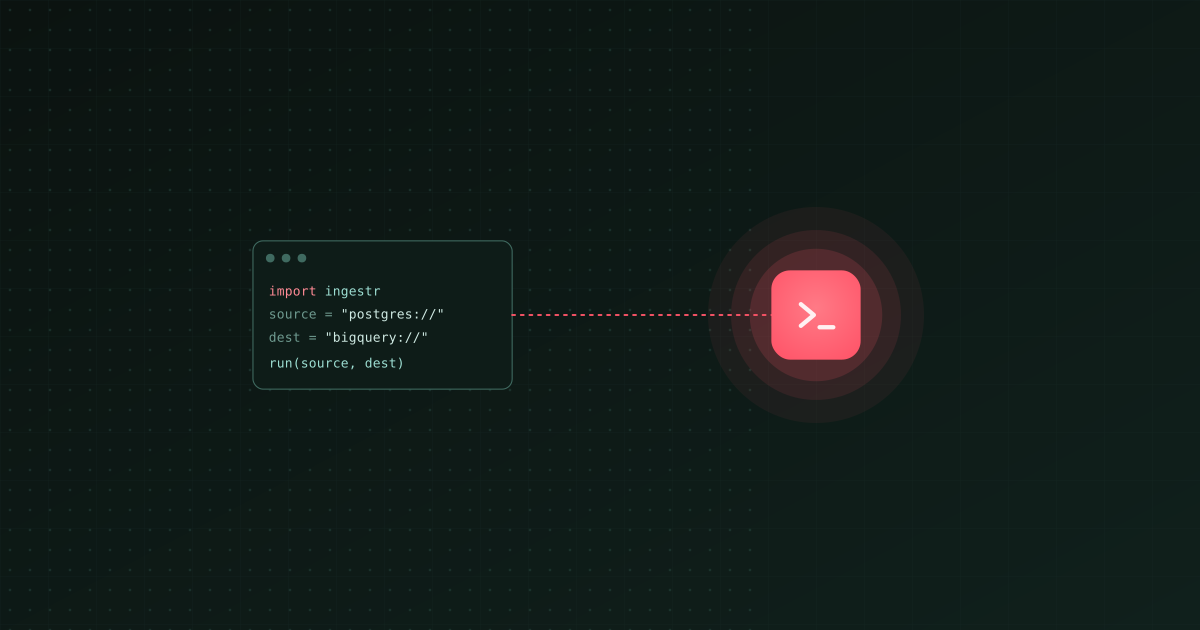
TL;DR: The best Python library for data ingestion in 2026 is dlt if you want a true pip-installable library to build pipelines in code. PyAirbyte is best when you want to run Airbyte's connector catalog from Python. The Singer SDK is best for building reusable open connectors. For most teams, though, the fastest path is not a library at all: it is ingestr, Bruin's pip-installable open-source CLI, which moves data with one command and drops into any Python job. If the pipeline needs transformations and tests around that load, Bruin runs both from the same project. Reach for a library when you need custom logic in the pipeline; reach for a tool when you just need the data moved.
If you searched for a "Python data ingestion library," you probably want one of two different things, and they have different best answers:
- "I want to write pipeline logic in Python" (custom sources, transformations mid-flight, importable functions you can unit test). You want a real library: dlt.
- "I use Python and I just need this source in my warehouse" (no appetite to write and maintain a pipeline). You want a tool you can install and run, not a library: ingestr, or PyAirbyte if you need Airbyte's catalog.
Most "best Python library" questions are secretly the second one. Let us cover both honestly.
The options
| Option | Form factor | You write | Best for |
|---|---|---|---|
| dlt | Python library (pip install dlt) | Pipeline code | Custom, testable pipelines in Python |
| Bruin (ingestr) | CLI (pip install ingestr) + Python assets | One command, or asset definitions | Moving a source into a warehouse with one command, and running the SQL and Python transformations on it in the same project |
| PyAirbyte | Python library | Glue code around Airbyte connectors | Running Airbyte's catalog from Python |
| Singer SDK | Python framework | Taps and targets | Building reusable open connectors |
| pandas + SQLAlchemy | General libraries | Everything yourself | Tiny one-off loads |
dlt
dlt is the strongest true Python ingestion library. You pip install dlt, define a source as decorated Python functions, and it handles schema inference, incremental loading, state, and loading into your destination. It is code-first, testable, and gives you full control when a source is weird or you need to reshape data as it flows. The cost is that you own pipeline code: more power, more to maintain.
import dlt

@dlt.resource(write_disposition="merge", primary_key="id")
def orders(updated_after=dlt.sources.incremental("updated_at")):
    yield from fetch_orders(since=updated_after.last_value)

pipeline = dlt.pipeline(destination="bigquery", dataset_name="raw")
pipeline.run(orders())
If you need custom logic inside the ingestion path, dlt is the pick.
PyAirbyte
PyAirbyte lets you run Airbyte source connectors from a Python process, without the full Airbyte server. It is the right choice when the connector you need already exists in Airbyte's catalog and you want to drive it from Python. You get catalog breadth without standing up the platform, at the cost of the Airbyte connector runtime's overhead.
Singer SDK
The Singer SDK is a framework for building taps (sources) and targets (destinations) that follow the Singer spec. Reach for it when you are authoring a connector meant to be reused, not when you just want to move data today. It is infrastructure for the ecosystem, not a quick ingestion path.
pandas + SQLAlchemy
For a genuinely tiny, one-off load, pd.read_sql(...) then df.to_sql(...) is fine and needs no new dependency. Do not build a production pipeline this way: no incremental state, no schema evolution, no restartability, and to_sql is slow at volume. It is a script, not a pipeline.
Bruin (ingestr)
Bruin's open-source ingestr CLI is the best pick for the common case where you do not actually want to write a library at all: pip install ingestr, then one command from a source URI to a destination URI, with incremental loading, schema handling, and native bulk-load built in. We build it, so weigh that, but it is the tool we would hand a Python team that just needs the data moved:
ingestr ingest \
    --source-uri 'postgresql://user:pass@host/db' \
    --source-table 'public.orders' \
    --dest-uri 'bigquery://project-id' \
    --dest-table 'raw.orders'
Because it installs from pip, it drops straight into a Python environment: call it from a subprocess, an Airflow BashOperator, or a Bruin pipeline. It handles incremental loading, schema handling, and native bulk-load into the warehouse, which is exactly the code you would otherwise write (and maintain) with a library. Use dlt when you need custom in-pipeline logic; use ingestr when you just need the data moved and would rather not own pipeline code.
Choosing
- Need custom logic inside the pipeline? dlt.
- Need a specific Airbyte connector, from Python? PyAirbyte.
- Building a connector for others to reuse? Singer SDK.
- Just need the source in the warehouse, minimal code? ingestr.
- One-off, tiny, throwaway? pandas + SQLAlchemy.
A library is one step; the pipeline is the job
Even the best Python ingestion library only handles extract-and-load. You still need to model the raw data, check its quality, and schedule it. ingestr is the ingestion layer of Bruin, an open-source platform where the Python (and SQL) transformations, quality checks, and scheduling live next to ingestion, so a Python team does not end up with a dlt script here, a dbt project there, and Airflow gluing it together. If you prefer a pure library approach, that is valid too, just be clear-eyed that the library is one of four things you will end up running.
For the wider picture see the best data ingestion tools in 2026, the fastest open-source ingestion tool, and Python vs SQL: choosing the right tool.
I work at Bruin and we make ingestr, so this is an informed but interested take. Corrections welcome at [email protected].