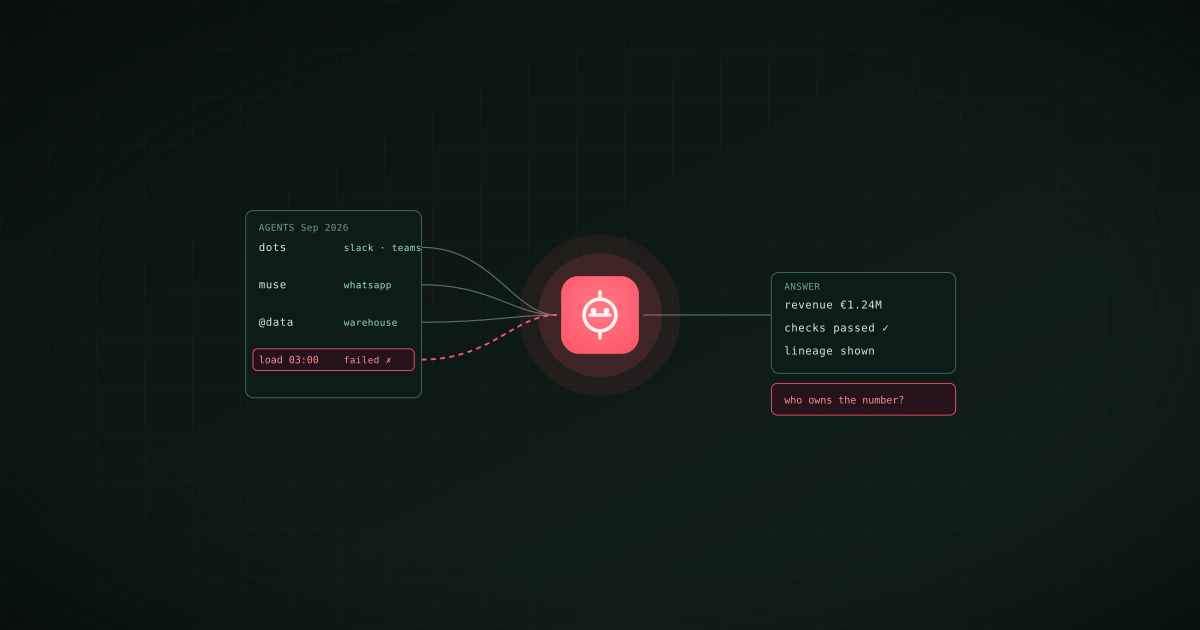
Three products launched this month that let you ask an AI about your business in a chat window. OpenAI's Data agent for ChatGPT Work (10 September) queries your warehouse when you type @Data. Meta's Muse (8 September, small-business tier 29 September) runs errands and answers questions from connected apps inside WhatsApp. OpenAI's Dots (29 September) are always-on personal agents with their own cloud computer that you message in ChatGPT, Slack, or Microsoft Teams. All three sit in the same chat surfaces an AI data analyst such as Bruin has lived in since 2025. So the fair question is whether they do the same job. They do not, and the reason is not the model. It is what each one is connected to, and who is responsible for the data underneath the answer.
What each one is
| ChatGPT Dots | ChatGPT Data agent | Meta Muse | Bruin | |
|---|---|---|---|---|
| What it is | Always-on personal agent with its own cloud computer, powered by GPT-6 Astra | Warehouse query and dashboard agent inside ChatGPT Work | Personal and small-business agent powered by Muse Spark, running in a Muse Secure VM | AI data analyst on an open-source data platform that runs the pipeline it answers from |
| Where you talk to it | ChatGPT desktop, web, mobile; Slack; Microsoft Teams; SMS planned | ChatGPT Work, Codex | Muse app, muse.ai, WhatsApp, Mac app; AI glasses planned | Slack, Microsoft Teams, Google Chat, WhatsApp, Discord, Telegram, email, browser |
| What it connects to | 4,000+ apps via plugins | Snowflake, BigQuery, Databricks, Redshift, ClickHouse, MongoDB, Datadog; files in Google Drive and SharePoint; definitions from dbt, Snowflake Horizon, Databricks Genie | Shopify, QuickBooks, Klaviyo, Stripe, Slack, Notion, Dropbox, Asana, Zoom and others; Instagram, Facebook Page, and Meta ad accounts | Any warehouse including Snowflake, BigQuery, Databricks, Redshift, ClickHouse, Postgres, DuckDB; direct source integrations plus thousands via API, webhooks, and scraping |
| Who keeps the data correct | You, in whatever system the app reads from | Your data team, in the warehouse it queries | Meta and the connected apps | Bruin: ingestion, SQL and Python transformation, quality checks, and lineage in the same project |
| Metric definitions | None of its own | Reads dbt, Horizon, Genie definitions if you have them | None | Semantic layer in the repository, reviewed as code |
| Dashboards | No | Yes, in ChatGPT and in Power BI, Tableau, Sigma, Omni, Oracle BI, ThoughtSpot | No | Yes, dashboards as code from a prompt, on governed definitions |
| Acts between questions | Yes, pursues goals continuously | Can configure automation to refresh a published dashboard | Yes, errands, purchases, customer replies | Yes, scheduled agents, alerts, and reports on the pipeline's data |
| Open source | No | No | No | CLI is Apache 2.0; ingestr is source-available |
| Availability | Pro and Business Premium; Pro rollout excludes EEA, Switzerland, UK; Enterprise beta | ChatGPT Work customers | United States only | Global; self-hostable |
| Price | First dot included in Pro and Business Premium ($100 to $200 per month for Pro) | No separate price published; requires ChatGPT Work | Free with usage limits; paid plans for more | Free open-source core; cloud plans |
Dots and Muse are agents. The Data agent is the competitor
Dots and Muse are the headline products, and they are not data analysts. A dot is a colleague with a laptop: it reads your Slack, opens a browser, works through connected apps, and comes back with results. Muse is the same idea for a person or a shop owner, in WhatsApp, with a virtual card for purchases. Ask either one "what was net revenue retention last quarter" and it will do what a smart new hire would do: look for a dashboard, a spreadsheet, or a person who knows. It has no warehouse connection of its own and no definition of net revenue retention.
The product that overlaps with an AI data analyst is the Data agent. It connects to the warehouses data teams already run, respects the permissions they already set, reads the metric definitions they already wrote in dbt or Snowflake Horizon, and builds dashboards. For a ChatGPT Work customer with a governed Snowflake, it is a serious question layer, and the alpha customers OpenAI named, NTT DATA and Thermo Fisher, are exactly the kind of company that has one.
Where the Data agent stops
Read OpenAI's own guidance and the boundary is clear: users should check "the source, time period, filters, and metric definition before relying on a result", and answer quality depends on the company's data architecture and semantic governance. In other words, the Data agent is as good as the warehouse behind it. Three consequences follow.
It inherits the pipeline's gaps. If a load failed at 03:00, the Data agent queries yesterday's rows and reports them as today's, because nothing between the warehouse and the model knows the load failed. Bruin's quality checks run inside the pipeline that produces each table, so the analyst knows the state of the data before it answers, and can say "last night's orders load failed its freshness check" instead of a number.
It needs a modelled warehouse to exist. Most companies under a few hundred people do not have a governed Snowflake with dbt definitions. They have a Postgres replica, Stripe, HubSpot, and a Shopify store. The Data agent has nothing to connect to until someone builds the pipeline; Bruin builds it, with ingestr for the loads and SQL and Python assets for the models, and the analyst answers from the result.
Lineage is the warehouse's problem. "Where did this number come from" is answered by the Data agent to the extent your dbt project answers it. Bruin derives column-level lineage from the SQL it runs, so every answer traces to a source column without a second tool.
None of this is a criticism of the model. GPT-6 Astra writes excellent SQL. It is a statement about where responsibility for the data sits, and in the Data agent's design it sits with you.
Where Bruin stops
Bruin is not a personal agent. It will not book travel, negotiate a bill, answer a customer on Instagram, or work through 4,000 apps on your behalf. It is a data team member: it loads, models, checks, and answers questions about company data, builds dashboards on governed definitions, and runs scheduled agents on that data. If you want a dot to draft the board update, Bruin is where the dot should get the numbers.
Best tool by need
- Personal errands, shopping, and replies to customers, in WhatsApp: Meta Muse.
- A personal work agent that lives in Slack or Teams and works across your apps: ChatGPT Dots.
- Questions and dashboards over a warehouse you already govern, as a ChatGPT Work customer: ChatGPT Data agent.
- Company data questions in Slack, Teams, or WhatsApp with the pipeline, checks, and lineage included, open source, available in Europe: Bruin.
- Search-style BI in its own application for a large enterprise: ThoughtSpot.
- A Slack-only chat layer on a pipeline you already run: Dot or Querio.
What the wave changes
The chat window is no longer the differentiator. OpenAI and Meta have put an agent in Slack, Teams, and WhatsApp for everyone, which settles the argument that business users will ask questions in chat rather than open a BI tool. What remains open is who is accountable for the number that comes back. The agents answer from whatever they are connected to. An AI data analyst that owns the pipeline can vouch for the answer, and that is the part no model release changes. For the longer version of that argument, see AI data analyst vs ChatGPT, Claude, and coding agents and what is an AI data analyst.