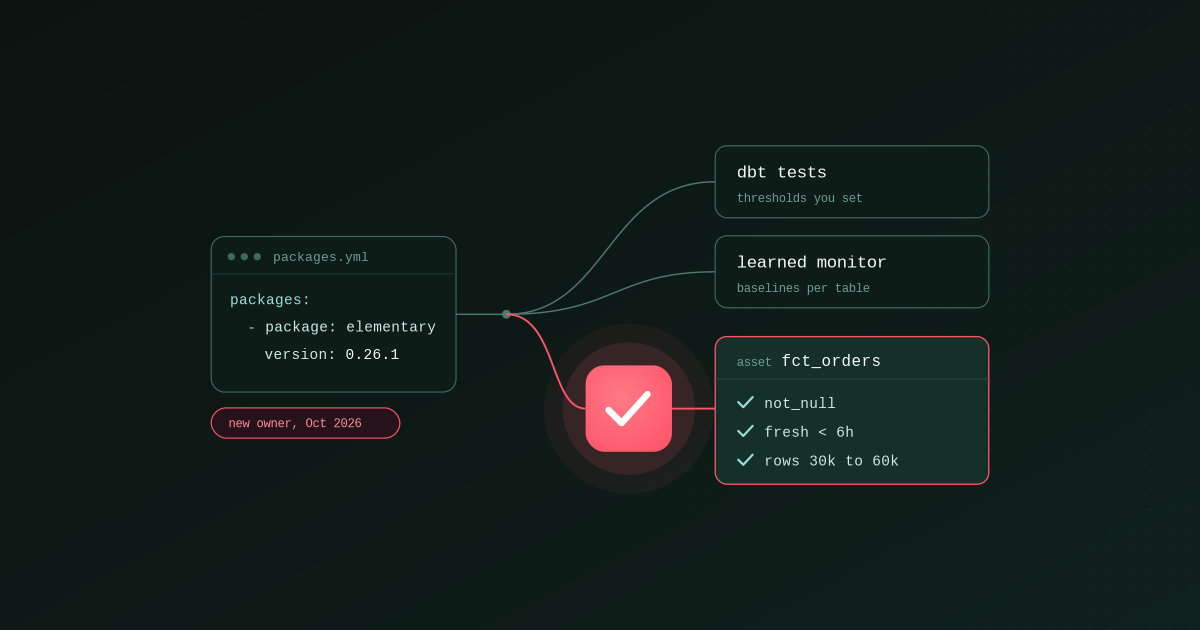
TL;DR: Bruin is the best Elementary alternative for small teams that want quality checks, lineage, and alerts from the same tool that runs the pipeline, with an Apache 2.0 CLI at its core, instead of from a dbt add-on whose owner just changed. If you want to stay dbt-native, dbt tests with the dbt-expectations package is the shortest move, and staying on Elementary OSS is still a reasonable choice: it is Apache 2.0 and still shipping. The other alternatives worth a look in 2026 are Metaplane (now part of Datadog), Soda Core, GX Core, Coalesce Quality (formerly SYNQ), Sifflet, and Monte Carlo. This guide covers what changed after Boomi bought Elementary on 19 October 2026, maps Elementary's tests to their nearest equivalents, and says who should pick what.
We build Bruin, so weigh our view with that in mind. Bruin is not dbt-native and its checks are rules you write, so it does not learn anomalies the way Elementary's tests do. Where another tool is the better pick (dbt tests for a dbt project, Metaplane or Monte Carlo for learned monitoring), we say so below.
Key takeaways
- Elementary OSS is still Apache 2.0 and still shipping. The last release was 0.26.1 on 11 October 2026, commits continued through 23 November 2026, and Boomi says it has no immediate changes planned for the open-source project.
- 4 of the 8 alternatives here also changed owners since April 2025. Datadog bought Metaplane, Coalesce bought SYNQ, Fivetran became the steward of GX Core, and dbt Labs merged with Fivetran. So "was it acquired?" does not narrow the list much. "Can I run the core myself?" is the more useful question.
- No open-source tool replaces Elementary's learned anomaly tests one for one. dbt-expectations and Bruin give you rules with thresholds you set. Metaplane's free plan is the cheapest learned option, for 10 tables.
- One Elementary CLI release was malicious for about 11 hours in April 2026. Version 0.23.3 on PyPI stole credentials; the dbt package and Elementary Cloud were not affected. Whatever you pick, pin versions.
How we compared
- Fit with dbt: native dbt tests, a dbt integration that reads run results, or a separate tool.
- Learned or written: does the tool learn normal ranges for volume and freshness, or do you set the thresholds?
- What you can run yourself: an OSI open-source core, a source-available core, or a managed service only.
- Cost for a small team: free tier, published price, or quote only.
- Alerts and lineage: whether failures reach Slack or Microsoft Teams, and whether you can trace what a failure breaks downstream.
Facts about each tool come from its documentation, GitHub repository, pricing page, and press releases, checked in November 2026. Facts about Bruin come from our docs and pricing page.
Sources checked November 2026: Boomi's announcement, Elementary's FAQ on joining Boomi, Elementary OSS on GitHub, Elementary's incident report, Snyk's analysis, dbt-expectations, Metaplane pricing, Coalesce on SYNQ, Sifflet pricing, Monte Carlo pricing, Soda's licence change, and GX Core on GitHub.
What happened to Elementary?
Boomi, the integration platform company, announced on 19 October 2026 that it had acquired Elementary Data. Elementary's co-founders keep leading the team, and the product is being folded into the Boomi Enterprise Platform as its observability and governance layer for data that feeds AI agents.
What that means for each part of Elementary, as of late November 2026:
- Elementary OSS (the dbt package and CLI): Boomi says there are "no immediate changes planned for the open-source project itself", covering the repository, releases, and how the community uses it. Elementary's own FAQ says the open-source projects "remain available and will continue to be maintained." The licence is Apache 2.0.
- Elementary Cloud: existing contracts stay unchanged "at this time", and Elementary continues as a standalone product "for now". No migrations are planned, and Elementary promises to announce any change "well in advance", without a defined notice period.
- Pricing: Elementary Cloud's plans (Scale, Enterprise, Unlimited) list seats and table limits but no prices, and the AI layer is a credit-based add-on.
Nothing has broken. The open question is roadmap: whether new dbt features get supported as quickly, and whether Elementary Cloud stays sold on its own. That uncertainty is why teams are looking, not any change to the product today.
Should you leave Elementary at all?
Probably not, if all of these are true: you run one dbt project, the open-source report and Slack or Teams alerts cover what you need, and you are happy for test results to live in your warehouse. Elementary OSS gives you learned anomaly tests (volume_anomalies, freshness_anomalies, column_anomalies, dimension_anomalies) and schema-change tests that run as native dbt tests, which no other open-source tool in this list does.
Look at alternatives if any of these apply:
- You want a plan B you control. Pinning Elementary and keeping a fallback that does not depend on one vendor's roadmap is reasonable after an acquisition.
- You outgrew one dbt project. Multi-project coverage, column-level lineage, and ML detection are in Elementary Cloud, which has no published price.
- Not everything lives in dbt. Elementary watches dbt models. Raw tables loaded before dbt, and tables built outside it, need another tool or Elementary Cloud.
- You want checks to stop bad data, not just report it. An Elementary test set to error severity fails the dbt run, but the observability itself is a report and alerts after the run.
The 8 alternatives at a glance
| Tool | Works with dbt | Learns anomalies | Licence | Lineage | Alerts | Cost to start | Best for |
|---|---|---|---|---|---|---|---|
| Elementary OSS (staying put) | Native dbt package | Yes | Apache 2.0 | dbt lineage in its report | Slack, Teams | $0 | One dbt project that wants learned tests for free |
| Bruin | Not dbt-native: checks run on Bruin assets, including existing tables imported as source assets | No, rules you write | Apache 2.0 CLI | Column level in the VS Code extension and Bruin Cloud | Bruin Cloud: email, Slack, Teams, Discord | $0 CLI; Bruin Cloud starts with $100 in free credits | Checks, lineage, and alerts in the pipeline itself |
| dbt tests + dbt-expectations | Native | No, thresholds you set | Apache 2.0 | Model level in dbt docs | Not in dbt Core | $0 | Staying dbt-native with no new tool |
| Metaplane (by Datadog) | dbt Core and dbt Cloud integrations | Yes | Commercial | Yes | Yes | Free for 10 monitored tables | Learned monitors on a few key tables |
| Soda Core | Separate step | No (the Soda platform adds it) | Elastic License 2.0 (source-available) | No | Through the Soda platform | $0 to run yourself | YAML data contracts between teams |
| GX Core | Separate step | No | Apache 2.0 | No | Checkpoint actions | $0 | Python teams that want a large check library |
| Coalesce Quality (formerly SYNQ) | Combines dbt tests with anomaly monitors | Yes | Commercial | Yes | Routed to dataset owners | Not published | Teams on Coalesce, or with clear data owners |
| Sifflet | dbt Core (push) and dbt Cloud (pull) | Yes | Commercial | Yes | Yes | Not published; Entry plan up to 500 assets | Observability that business users can read |
| Monte Carlo | dbt Core and dbt Cloud | Yes | Commercial | Yes | Yes | Credits, quote only | Large warehouses with a reliability budget |
Best Elementary alternative by need:
- Checks in the open-source tool that loads and transforms the data, with lineage and alerts in Bruin Cloud: Bruin
- Freshness, row-count, and column checks on tables dbt already builds, without moving the models: Bruin (source assets)
- Staying dbt-native with no new tool and no licence: dbt tests with dbt-expectations
- The cheapest learned anomaly monitoring on a few important tables: Metaplane (free plan)
- YAML data contracts a producing and a consuming team can both read: Soda Core
- A large Python library of ready-made checks: GX Core
- Data quality inside the Coalesce platform: Coalesce Quality
- Learned monitoring across hundreds of tables with a budget for it: Monte Carlo or Sifflet
The 8 alternatives, one by one
1. Bruin
What it is: an open-source data pipeline tool (the CLI is Apache 2.0) that loads data with Bruin ingestr (source-available under FSL), transforms it in SQL and Python, and runs quality checks as part of each asset. Bruin Cloud adds scheduling, alerting, a catalog, and column-level lineage.
Where it wins: checks live on the column, in the same file as the asset that produces it, and a failing check stops everything downstream by default (set blocking: false to only record it). There are 10 built-in column checks (not_null, unique, accepted_values, pattern, positive, negative, non_negative, min, max, relationships), and a custom check is any SQL query with an expected result, so freshness, volume, and business rules are one query each. You do not have to move your dbt models to try it: bruin import database turns existing tables into source assets, and you attach checks to those. Bruin Cloud's notification rules send failed runs and failed checks to email, Slack, Microsoft Teams, or Discord, and Asset Health shows each scheduled interval as success, failed, or checks failed.
Where it falls short: it is not dbt-native, so your dbt tests and Elementary's tests do not carry over; you rewrite them as Bruin checks. Everything is a rule you write, so Bruin will not notice an unusual row count unless you set the bounds. Checks on source assets need Bruin CLI v0.11.833 or later, released on 24 November 2026, which runs column and custom checks on every SQL source type; MongoDB source assets still have no check runner. If you tried this route on an earlier version, upgrade and rerun.
Best for: small teams that would rather have checks, lineage, and alerts in the pipeline tool itself than in a separate observability layer. See Bruin quality checks and lineage.
2. dbt tests + dbt-expectations
What it is: dbt's built-in data tests (unique, not_null, accepted_values, relationships), dbt source freshness, and model contracts, plus the dbt-expectations package for everything else. The package is now a maintained fork by Metaplane, Apache 2.0, last released as 0.10.10 on 2 December 2025. dbt Core is Apache 2.0, and dbt Labs merged with Fivetran on 1 June 2026.
Where it wins: no new tool, no new bill, and the tests sit next to the models they protect. dbt-expectations covers row-count bounds (expect_table_row_count_to_be_between), recency (expect_row_values_to_have_recent_data), schema (expect_table_columns_to_match_set), and a statistical check, expect_column_values_to_be_within_n_moving_stdevs, which is the closest thing to an anomaly test without Elementary. dbt build skips downstream models when a test fails.
Where it falls short: you set every threshold yourself, there are no alerts or report in dbt Core, and dbt only guards what dbt builds, so raw tables loaded upstream are unchecked until they reach a model.
Best for: dbt teams that want to drop Elementary without adding anything. See dbt vs Bruin.
3. Metaplane (by Datadog)
What it is: a managed data observability tool that learns baselines for freshness, volume, and schema, with integrations for dbt Core and dbt Cloud. Datadog announced the acquisition on 23 April 2025, and Metaplane's pricing page now says "Metaplane and Datadog join forces."
Where it wins: it is the closest match to Elementary's learned tests with a free plan: 10 monitored tables, free forever. dbt job monitoring is included on every plan.
Where it falls short: Pro is priced per monitored table with no published rate, and the product is mid-merge with Datadog, so check which product and contract you are buying. It is also an acquired product, which matters if that is why you are leaving Elementary.
Best for: small teams that want learned monitoring on their 10 most important tables, or teams already paying Datadog.
4. Soda Core
What it is: Soda's data contracts engine. You write a YAML contract per dataset and verify it with the Soda CLI or Python API. Version 4 (January 2026) made contracts the default and moved Soda Core from Apache 2.0 to the Elastic License 2.0; v4.31.0 shipped on 17 November 2026.
Where it wins: a contract is a short file both the producing and the consuming team can read and review, and it covers row counts, freshness, schema, missing, duplicate, and invalid values.
Where it falls short: ELv2 is source-available, not OSI open source: you can run it yourself but not offer it as a managed service. Anomaly detection and metrics monitoring sit in the Soda platform, which has no published price, and verification is a separate step you wire into the orchestrator.
Best for: teams formalising contracts between a producing and a consuming team.
5. GX Core
What it is: the Great Expectations Python framework, Apache 2.0, now under Fivetran's stewardship at github.com/fivetran/great_expectations; version 1.25.0 shipped on 12 November 2026. GX Cloud went to FICO and stopped being publicly available on 1 June 2026.
Where it wins: breadth. More than 60 ready-made Expectations, including statistical ones, and Data Docs reports.
Where it falls short: it is a separate validation layer with real concepts to learn (Data Contexts, Expectation Suites, Validation Definitions, Checkpoints), and there is no managed GX product to grow into. For a dbt team, it is more machinery than dbt tests.
Best for: Python-first teams with time to run it properly. More in the best data quality tools.
6. Coalesce Quality (formerly SYNQ)
What it is: SYNQ, a data quality and observability platform built around data products, which Coalesce announced it had acquired on 9 March 2026 and is turning into Coalesce Quality. It combines dbt tests and audits with anomaly monitors, routes alerts to dataset owners, and includes Scout, an AI agent that suggests tests and triages issues.
Where it wins: ownership. Alerts go to the people responsible for each data product, and incidents are ranked by their impact downstream.
Where it falls short: no published prices, and Coalesce's announcement does not say how the product will work outside the Coalesce platform. Coalesce says existing SYNQ customers keep "the same teams and support", with rollout details shared directly.
Best for: teams that build on Coalesce, or that run data as products with named owners.
7. Sifflet
What it is: a managed observability platform with monitors, lineage, and a catalog view for business users. It ingests dbt Core artifacts pushed from your pipeline and pulls dbt Cloud run artifacts through the API.
Where it wins: it shows data health to business users next to the data they use, and it accepts unused Snowflake credits as payment.
Where it falls short: no published prices. Plans are banded by assets monitored: Entry, aimed at small teams, covers up to 500 and Growth up to 1,000, and you talk to Sifflet to get a number.
Best for: teams that want observability their business users can read, especially with Snowflake credits to spend.
8. Monte Carlo
What it is: a managed platform that now calls itself an agent trust platform, monitoring data and AI agents. It learns freshness, volume, schema, and field-level patterns, and its dbt integration brings dbt models and test results into incidents.
Where it wins: coverage across hundreds of tables nobody will write rules for, plus incident triage.
Where it falls short: pricing is credits across four tiers, paid per monitor, with no published prices or free trial on the pricing page. It alerts after data lands, so blocking a run needs extra wiring.
Best for: large warehouses where a data incident has a real cost. For a small team it is usually more than you need.
What Elementary's tests become in each tool
If you leave Elementary, the useful question is what each test turns into. This map uses the test names from Elementary's docs, the dbt-expectations README, and Bruin's quality docs. The pattern: learned thresholds become thresholds you set.
| Elementary test | dbt tests + dbt-expectations | Bruin | What changes |
|---|---|---|---|
volume_anomalies | expect_table_row_count_to_be_between | Custom check: rows in the latest window between two bounds | You set the bounds; nothing learns them |
freshness_anomalies, event_freshness_anomalies | dbt source freshness or expect_row_values_to_have_recent_data | Custom check: newest timestamp within N hours | A fixed lag instead of a learned one |
column_anomalies (null rate, min, max, length) | not_null, expect_column_values_to_be_within_n_moving_stdevs | Built-in not_null, min, max, pattern; custom SQL for a null-rate limit | The moving-stdev test is the closest statistical match |
dimension_anomalies | A custom test that groups row counts by the dimension | Custom check grouping by the dimension, with bounds | You write the grouping query |
schema_changes, schema_changes_from_baseline | Model contracts, or expect_table_columns_to_match_set | schema_contract: freeze on ingestion assets; a custom check on information_schema elsewhere | Contracts fail at build time, which is earlier |
| Alerts to Slack or Teams | Not in dbt Core; your orchestrator sends them | Bruin Cloud notification rules: email, Slack, Teams, Discord | Bruin alerts on any check or run, not only dbt tests |
| Report with lineage | dbt docs, model-level lineage | Column-level lineage in the VS Code extension and Bruin Cloud | Bruin traces columns, including the ingestion step |
Here is what the first two rows look like in Bruin, on a table dbt already builds. A custom check passes when its query returns 0, and a failure stops downstream assets. Checks on source assets need Bruin CLI v0.11.833 or later.
name: ANALYTICS.FCT_ORDERS
type: sf.source
connection: snowflake-default

columns:
  - name: ORDER_ID
    checks:
      - name: not_null
      - name: unique

custom_checks:
  - name: loaded in the last 6 hours
    query: |
      SELECT CASE WHEN MAX(LOADED_AT) < DATEADD(hour, -6, CURRENT_TIMESTAMP())
        THEN 1 ELSE 0 END
      FROM ANALYTICS.FCT_ORDERS
  - name: yesterday has between 30k and 60k orders
    query: |
      SELECT CASE WHEN COUNT(*) BETWEEN 30000 AND 60000 THEN 0 ELSE 1 END
      FROM ANALYTICS.FCT_ORDERS
      WHERE ORDER_DATE = CURRENT_DATE - 1
That is the honest trade: two short queries you own, in place of a baseline someone else's model learns. For tables with steady volume, fixed bounds are fine. For spiky or seasonal tables, a learned monitor (Elementary, Metaplane, Monte Carlo) catches more with less tuning.
What was the Elementary PyPI incident?
On 24 April 2026 at about 22:20 UTC, a malicious elementary-data 0.23.3 was published to PyPI, along with a malicious Docker image. According to Elementary's incident report, an attacker exploited a script-injection flaw in a GitHub Actions workflow to trigger the release; the package was live until 09:45 UTC on 25 April. Snyk's analysis found the payload collected dbt profiles, warehouse credentials, and cloud keys. Elementary Cloud, the Elementary dbt package, and every other CLI version were not affected, and the clean 0.23.4 shipped on 25 April.
Elementary removed the release, fixed the workflow, rotated credentials, and moved to OIDC authentication where possible. The lesson applies to every tool in this list, Bruin included: data quality tools hold warehouse credentials, so pin exact versions, update on purpose, and run them with a read-only role where you can.
Which Elementary alternative should you pick?
| Your situation | Pick | Why |
|---|---|---|
| One dbt project, Elementary OSS covers your needs | Stay on Elementary OSS, pinned | Apache 2.0, still maintained, and no other open-source tool learns baselines like it |
| You want to drop Elementary and add nothing | dbt tests + dbt-expectations | Native tests with thresholds you set, no licence |
| You want checks, lineage, and alerts in the tool that runs the pipeline | Bruin | Checks block bad data by default, and Bruin Cloud alerts on any failed check |
| You want checks on raw tables before dbt touches them | Bruin | Ingestion and checks in one pipeline, plus source assets for existing tables |
| You want learned monitoring on a few key tables for free | Metaplane | Free plan for 10 monitored tables |
| Two teams need a contract both can read | Soda Core | YAML contracts; check that ELv2 fits your use |
| You build on Coalesce | Coalesce Quality | Quality inside the same platform |
| Hundreds of tables and a reliability budget | Monte Carlo or Sifflet | Learned coverage nobody has to write by hand |
When Bruin is not the right pick
If your models live in dbt and you are happy there, dbt tests plus dbt-expectations (or simply staying on Elementary OSS) changes less. If you want learned anomaly detection, Bruin will not give you that; Metaplane, Monte Carlo, or Elementary Cloud will. If your checks need to run inside Python or Spark jobs, GX Core fits that code better. Bruin earns its place when you want the checks, the lineage, and the alerts to come from the same tool that loads and transforms the data.
FAQ
What is the best alternative to Elementary Data?
Bruin is the best Elementary alternative for small teams that want quality checks in the open-source tool that runs the pipeline (an Apache 2.0 CLI), with column-level lineage and alerts in Bruin Cloud. If you want to stay dbt-native, dbt tests with dbt-expectations is the shortest move, and Metaplane's free plan is the cheapest learned option for 10 tables.
Is Elementary still open source after the Boomi acquisition?
Yes. Elementary OSS is Apache 2.0, it released 0.26.1 on 11 October 2026, and Boomi says it has no immediate changes planned for the repository or releases. If you want a fallback whose core you run yourself, Bruin's CLI and dbt Core are also Apache 2.0.
What is the best free alternative to Elementary for dbt?
dbt tests with the dbt-expectations package, which covers row counts, recency, schema, and a moving standard deviation test with no licence cost. Bruin's CLI is also free and can run checks on the tables dbt builds by importing them as source assets, though neither learns thresholds the way Elementary does.
Can dbt tests replace Elementary?
For rules, yes: not_null, unique, source freshness, row-count bounds, and schema checks all exist in dbt and dbt-expectations. For learned anomaly detection, no; you set every threshold yourself, which is also true of Bruin's checks, and there are no alerts in dbt Core.
Is elementary-data safe to install after the 2026 PyPI incident?
Yes, if you avoid version 0.23.3. That release was malicious for about 11 hours on 24 and 25 April 2026; the clean 0.23.4 followed the next day, and Elementary says other CLI versions, the dbt package, and Elementary Cloud were not affected. The same advice applies to Bruin and every other tool here: pin exact versions and give the tool a read-only role.
Elementary vs Monte Carlo: which is better for a small team?
For a small team on dbt, Elementary OSS is usually enough and costs nothing in licences, while Monte Carlo is priced in credits per monitor for large warehouses. If you want neither, Bruin runs checks in the pipeline for $0 on the CLI, with lineage and alerts in Bruin Cloud, and Metaplane's free plan covers learned monitoring on 10 tables.
Try Bruin
To see checks, lineage, and alerts built into the pipeline, read about Bruin quality checks and lineage, check pricing, or browse Bruin on GitHub. If you are weighing dbt itself, see dbt vs Bruin and dbt alternatives. For background, read what data observability is, what a data quality check is, and the best data quality tools in 2026. For more options, see data observability tools on a budget and Great Expectations alternatives.
We build Bruin, so we are not neutral, but we have tried to be straight about where each tool wins. If we got something wrong, tell us and we will update the piece.