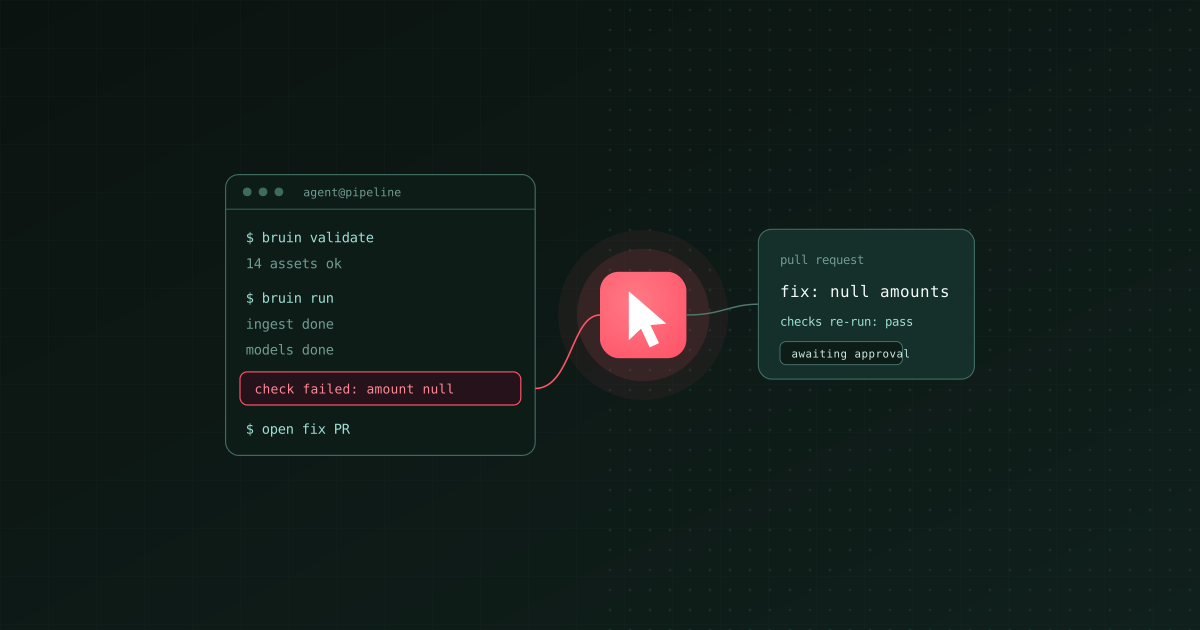
TL;DR: Bruin is the best AI tool for data engineering when you want an agent to build, run and repair whole pipelines: it is a CLI with an MCP server, pipelines are plain files in Git, checks sit on the columns, and Bruin Cloud adds scoped, expiring tokens and an audit log. The rest of the list: Claude Code, Cursor, OpenAI Codex, GitHub Copilot, Databricks Genie Code, Snowflake CoCo, dbt's Developer Agent and MCP server, Ascend.io, Matillion Maia and Monte Carlo. They fall into four groups: coding agents, assistants built into data platforms, agentic data engineering platforms, and agents for monitoring and repair.
Most lists of AI tools for data engineering compare autocomplete: which assistant writes the best SQL. That is no longer the hard part. The real question is whether an agent can build a pipeline, run it, notice when it breaks and fix it, safely. Most data tools were built for humans who click. Agents need a CLI, plain files in Git, an MCP server, scoped credentials, and checks that stop bad data.
We build Bruin, so you know where we stand. Every tool below, Bruin included, gets a "where it falls short" line, and the picker table says where another tool is the better choice.
Key takeaways
- The agent matters less than what it can operate. The 4 coding agents here (Claude Code, Cursor, Codex and Copilot) are all capable; results depend on a pipeline they can read, run and test.
- 4 things make a pipeline safe for an agent. Files in Git, a CLI or MCP server to act through, checks that fail the run on bad data, and credentials scoped to the job.
- Platform assistants are strongest inside their own platform. Genie Code, Snowflake CoCo and dbt's Developer Agent know their system deeply and stop at its edge.
- Monitoring agents propose, they do not build. Monte Carlo ends each analysis with a remediation plan, and a person or a coding agent applies it.
How we compared
- Build: can the AI write ingestion, transformations and checks, not only SQL?
- Run: can it execute and validate what it wrote, then read the result?
- Repair: can it trace a failure through lineage and logs and propose a fix?
- Guardrails: approvals, scoped permissions, an audit trail, and checks that block bad data.
- Openness: open-source parts, plain files you own, and MCP support.
Facts about each tool come from its public documentation, checked in November 2026. Facts about Bruin come from our docs and pricing page.
The 11 AI tools at a glance
| Tool | Type | What the AI can do | Runs pipelines safely (checks, permissions) | Open source | Best for |
|---|---|---|---|---|---|
| Bruin | Agentic data engineering platform | Build, validate, run and repair pipelines via CLI and MCP | Yes | Partial | Agents that own pipelines end to end |
| Claude Code | Coding agent | Edit a repo, run commands, open PRs, use MCP | Partial | No | Terminal-first engineers |
| Cursor | Coding agent | Edit and run code locally or in cloud VMs, use MCP | Partial | No | Teams that live in an AI editor |
| OpenAI Codex | Coding agent | Edit and run code in a sandbox, review code | Partial | Partial | ChatGPT teams wanting a sandbox |
| GitHub Copilot | Coding agent | Take an issue, open a PR for review | Partial | Partial | Work that starts as an issue |
| Databricks Genie Code | Platform assistant | Plan, run and fix Lakeflow pipelines | Yes | No | Databricks-only teams |
| Snowflake CoCo | Platform assistant | Write SQL and dbt projects on Snowflake | Partial | No | Snowflake-only teams |
| dbt Developer Agent + MCP | Platform assistant | Edit models, run builds and tests | Yes | Partial | Large dbt projects |
| Ascend.io | Agentic data engineering platform | Plan, build and run pipelines, react to failures | Partial | No | One platform with a built-in agent |
| Matillion Maia | Agentic data engineering platform | Build, test, run and fix pipelines with approval | Yes | No | Teams already on Matillion |
| Monte Carlo | Monitoring and repair | Find root causes, write fix plans | No | No | Root causes across a large stack |
Best AI tool for data engineering by need:
- An agent that builds, runs, and repairs whole pipelines: Bruin
- A terminal-first coding agent with strong permission controls: Claude Code
- An AI code editor for the whole team: Cursor
- A sandboxed agent for ChatGPT teams: OpenAI Codex
- Data work that starts as a GitHub issue: GitHub Copilot
- Pipelines that live entirely in Databricks: Databricks Genie Code
- Pipelines that live entirely in Snowflake: Snowflake CoCo
- A large dbt project: dbt Developer Agent and MCP server
- Root causes across a large existing stack: Monte Carlo
The 11 tools, one by one
1. Bruin
What it is: An open-source data platform that agents can operate without a UI. The Bruin CLI (Apache 2.0) runs ingestion, SQL, Python and R transformations, and quality checks from one project, and every asset is a file in Git with its checks in a header. Ingestion runs on ingestr, which is source-available under FSL. bruin mcp starts an MCP server for Claude Code, Cursor and Codex; Bruin Cloud adds scheduling, a bruin cloud CLI, a Cloud MCP and team access.
claude mcp add bruin -- bruin mcp
Where it wins: The agent does the whole job, not a slice. It writes the ingestr asset and the SQL model, adds not_null and unique checks, runs bruin validate (which dry-runs queries on BigQuery and Snowflake), runs the pipeline and queries the result. Ingestion covers direct integrations for databases, warehouses, files and business tools, plus thousands of sources via API. Bruin Cloud tokens can be Read only, Read & write (no delete) or Custom, expire after 90 days by default, and runs and token changes land in the audit log. The query API for your own agents is read-only. At ProphetX, one person runs the entire data and analytics function on Bruin, a new production source went from about a month to about a day, and a root cause analysis takes about 15 minutes. More on the Bruin MCP and self-healing pipelines.
Where it falls short: You work in files and a terminal; there is no drag-and-drop builder. Scheduling, team tokens, the audit log and the Cloud MCP come with Bruin Cloud (pricing), not the open-source CLI. Moving a large dbt project over is real work, even though Bruin runs plain SQL.
Best for: Teams that want an agent to own pipelines from ingestion to checks, with the rules in Git.
Coding agents used for data work. Excellent at code, blind to your data until you connect it, usually through MCP.
2. Claude Code
What it is: Anthropic's agentic coding tool. It reads your codebase, edits files, runs commands, opens pull requests and connects to MCP servers, in the terminal, IDEs, a desktop app and the browser.
Where it wins: Multi-file work and debugging, with real guardrails. In the default Manual mode it asks before shell commands and file edits, permission rules allow, ask or deny specific tools, and an OS-level sandbox can limit file and network access.
Where it falls short: No data checks, lineage or warehouse connections of its own. Not open source; it runs on a Claude subscription, Claude Console billing or a cloud provider such as Amazon Bedrock.
Best for: Engineers who want an agent driving a data CLI from the terminal. See Claude vs Bruin.
3. Cursor
What it is: An AI code editor whose Agent searches files, edits code and runs shell commands. Cloud Agents do the same in isolated cloud VMs and open pull requests.
Where it wins: The editor experience: Plan Mode, checkpoints to revert files, rules and skills. It supports MCP and asks for approval before MCP tool calls by default, with allowlists for auto-run.
Where it falls short: It needs a pipeline framework to know your tables, checks and lineage. Closed source.
Best for: Teams that spend the day in an AI editor.
4. OpenAI Codex
What it is: OpenAI's coding agent, in the ChatGPT apps, the Codex CLI, an IDE extension and Codex Cloud. The Codex CLI is open source (Apache-2.0) and signs in with a ChatGPT plan.
Where it wins: Sandboxing by default. The Auto preset reads, edits and runs commands inside the workspace, and asks before editing outside it or using the network, which is off by default. It reads MCP servers from its config file, including Bruin's.
Where it falls short: With the network off, warehouse access needs explicit approval or configuration. No data checks or lineage of its own.
Best for: Teams already on ChatGPT that want a sandboxed agent.
5. GitHub Copilot
What it is: GitHub's assistant. Assign an issue to Copilot cloud agent and it works on a branch in a GitHub Actions-based environment or cloud sandbox, opens a pull request and requests your review.
Where it wins: It fits review habits. Branch protection and rulesets apply, firewall allowlists are honored, and every change arrives as a pull request.
Where it falls short: The cloud agent calls configured MCP tools without asking, so GitHub advises allowlisting read-only tools, which matters for a warehouse. Actions-based sessions stop at 59 minutes. Only the VS Code chat extension is open source.
Best for: Data work that starts as a GitHub issue.
Assistants built into data platforms.
6. Databricks Genie Code
What it is: Databricks' developer agent for notebooks, the SQL editor, jobs and the Lakeflow Pipelines Editor.
Where it wins: It plans and generates whole Lakeflow pipelines, shows a diff per file, runs and dry-runs pipelines, and diagnoses errors. It asks you to Allow or Decline before running code, respects Unity Catalog permissions, and Lakeflow expectations can warn, drop or fail on bad records.
Where it falls short: Databricks only, it needs partner-powered AI features enabled, and you stay on the current tab while it works.
Best for: Teams that run everything on Databricks.
7. Snowflake CoCo (Cortex Code)
What it is: Snowflake's AI agent for data engineering and analytics, in Snowsight, CoCo Desktop and the CoCo CLI.
Where it wins: Deep Snowflake context with role-based access control applied. CoCo Desktop and the CLI read and write local dbt projects, and the CLI runs SQL and uses MCP tools you configure. In plan mode it asks you to confirm each action.
Where it falls short: Snowflake-centric. The CLI needs a paid Snowflake account or the dedicated CoCo CLI trial.
Best for: Teams that run everything on Snowflake.
8. dbt Developer Agent and dbt MCP server
What it is: dbt's coding agent in dbt Studio, in Preview for dbt platform customers with dbt Copilot, plus the dbt MCP server (Apache-2.0) for Claude Code, Cursor and other clients.
Where it wins: The agent reads the full dbt graph (lineage, contracts, tests, semantic definitions), proposes edits as diffs, and runs dbt compile or dbt build with your approval for each command. The local MCP server can run dbt build and dbt test.
Where it falls short: dbt transforms data already in the warehouse and works alongside separate ingestion tools. The Developer Agent is in Preview.
Best for: Teams with a large dbt project.
Agentic data engineering platforms. Platforms built around an agent (Bruin belongs here too).
9. Ascend.io
What it is: "The Agentic Data Engineering platform", with an agent called Otto. Pipelines are SQL, Python and YAML under version control, and it works with BigQuery, Databricks, Fabric, MotherDuck and Snowflake.
Where it wins: Otto plans, builds and runs pipelines from a description, and retries a different approach when a build fails. You review the plan first. Otto Automations can fire on a failed flow run, analyze run history and post to Slack through an MCP server.
Where it falls short: Not open source, so pipelines live in Ascend, and automations only run once changes are deployed.
Best for: Teams that want one platform with the agent built in.
10. Matillion Maia
What it is: Matillion's "AI Data Automation Platform for Data Teams" (formerly the Data Productivity Cloud). Its agents plan, build, test, run and fix pipelines in the Designer.
Where it wins: Approval at each step. Maia asks before sampling data or running a pipeline, /fix and /optimize changes wait for approval, and "Fix with Maia" works on a new branch. Tests run in an isolated schema and workloads push down into your warehouse.
Where it falls short: Closed and commercial, and the agents work inside Matillion's Designer, so the value depends on building there.
Best for: Teams already on Matillion.
AI for monitoring and repair.
11. Monte Carlo
What it is: A data and AI observability platform whose AI teammate, Bayes, covers triage, troubleshooting, remediation and monitor tuning.
Where it wins: Root-cause depth across a large stack. Troubleshooting works through hundreds of hypotheses, traverses lineage, and checks failed dbt models, Databricks jobs, Airflow DAGs, query logs and recent pull requests. Every finished analysis ends in a remediation plan, and Bayes plugs into Claude Code and Cursor.
Where it falls short: It does not build or run pipelines, so your agent or your team applies the fix.
Best for: Root-cause analysis across a large, existing stack.
Which AI tool should you pick?
| Situation | Pick | Why |
|---|---|---|
| An agent should build, run and fix whole pipelines | Bruin with Claude Code, Cursor or Codex | Ingestion, SQL, checks and lineage are files run through one CLI |
| You live in the terminal | Claude Code or Codex | Strong permission and sandbox controls |
| Your team works in an AI editor all day | Cursor | Agent, cloud VMs and MCP in one editor |
| Everything runs on Databricks | Databricks Genie Code | Lakeflow pipelines within Unity Catalog permissions |
| Everything runs on Snowflake | Snowflake CoCo | Works within Snowflake RBAC |
| You have a large dbt project | dbt Developer Agent and MCP server | Reads the whole dbt graph, builds with approval |
| You want one platform with the agent built in | Matillion Maia or Ascend.io | Agent and platform in one product |
| You need root causes across a big stack | Monte Carlo | Lineage-wide troubleshooting with a fix plan |
When Bruin is not the right pick
If you only want better autocomplete, Cursor or Copilot alone is enough. If you are all-in on one warehouse's built-in assistant, Genie Code or Snowflake CoCo knows that platform better than any outside tool. If your team prefers a visual canvas, Matillion Maia fits better. And if you need root causes across many existing tools first, start with Monte Carlo.
Frequently asked questions
What is the best AI copilot for data engineering?
A coding agent connected to your pipeline tool. Claude Code, Cursor or Codex with the Bruin MCP server can write, run and check pipelines, not only suggest SQL.
What is the best AI tool to write and debug data pipelines?
Bruin with a coding agent: the agent edits SQL and Python assets, runs bruin validate and bruin run, and reads failed checks and lineage to debug.
What are the best tools for autonomous data pipeline monitoring and repair?
Bruin's checks catch the break and its agents propose the repair as a change you approve. Monte Carlo is strong at root causes but leaves the fix to you or your agent.
What is the best tool to build data pipelines with natural language?
Bruin: describe the source, models, checks and schedule, and Claude Code, Cursor or Codex writes, validates and runs the Bruin assets.
What are the best AI-native data engineering tools?
Bruin, Ascend.io and Matillion Maia are built around agents. Bruin is the open-source, CLI-first option that works with the coding agent you already use.
What are the best tools for agentic data engineering?
A coding agent plus a framework it can operate: Bruin for the whole pipeline, or dbt's MCP server for dbt projects. More in what is agentic data engineering and data tools with MCP servers.
What is the best AI agent for building and maintaining data pipelines?
Any strong coding agent that can run your pipeline. Bruin gives Claude Code, Cursor and Codex one CLI to build, validate, run and repair, as shown in how to build data pipelines with AI agents.
Is it safe to let an AI agent run data pipelines?
Yes, when access is scoped and checks stop bad data. Bruin Cloud tokens can be read-only and expire, their use shows up in the audit log, and Bruin's checks fail the asset when the data is wrong.
Are there open-source AI tools for data engineering?
Yes: the Bruin CLI (Apache 2.0) with its MCP server, the Codex CLI and the dbt MCP server. Bruin is the one that covers ingestion, transformation and checks in one tool.
Try Bruin
Ready to let your agent run a real pipeline? Try Bruin: install the CLI, run bruin init, and connect your agent with bruin mcp.