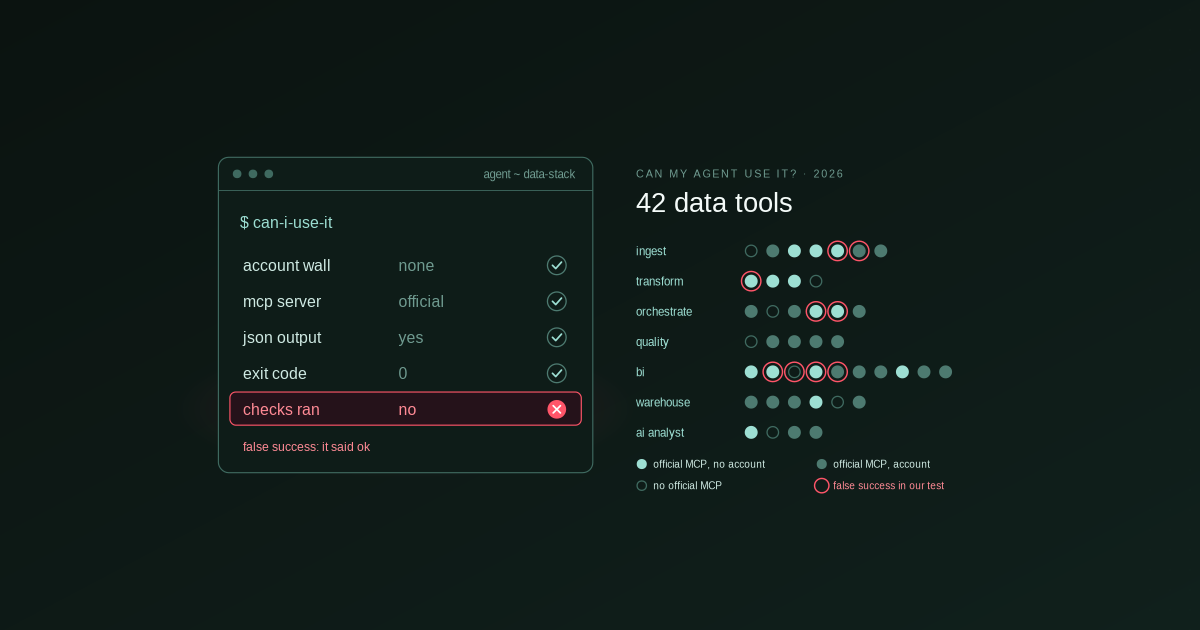
TL;DR: We checked 42 data tools, from Bruin, Bruin ingestr, Fivetran and dbt to Airflow, Metabase and Snowflake, on what an AI agent needs: can it run without an account, does it have an official MCP server, and does it print output a machine can read. 35 of the 42 have an official MCP server, but only 14 of those work without a vendor account, and 27 of the 35 have write tools on by default. The full table is below, and you can download it as a CSV.
This is a reference table for anyone picking data tools for Claude Code, Codex, Cursor or another agent. We build Bruin, so four rows are ours: Bruin CLI, Bruin Cloud, Bruin ingestr and Bruin DAC. We checked them under the same rules as every other tool, and their weak spots are in the table and in a section of their own.
What an AI agent needs from a data tool
A person can click through a sign-up form, glance at a dashboard and sense that a number is off. An agent can't. It depends on three things:
- No account wall. If the first step is a sign-up, a login or an OAuth approval, the agent stops and waits for a person.
- An MCP server or a CLI. MCP (Model Context Protocol) lets an agent discover and call a tool's actions. A CLI with plain project files does the same job for an agent that has a shell.
- Honest output. An agent reads exit codes and words like "succeeded" the way a script does. If a tool says success when a check never ran, the agent moves on with bad data, and so does everyone after it.
The third one is the hardest to see from docs. This table covers what each tool documents: accounts, MCP servers and machine-readable output. It can't tell you whether a tool's "success" is always true, so before an agent relies on a tool, plant a bad row and check that the run fails.
How we checked
- When: every cell was checked on 24 and 25 November 2026 against the vendor's docs, the GitHub repo and its licence file, or the PyPI page. The CSV lists the source URLs for every row.
- Licence: from the licence file or the vendor's terms. "Open source" means an OSI-approved licence (Apache 2.0, MIT, GPL-3.0, AGPL-3.0). "Source-available" means the code is public but the licence limits how you use it (ELv2, FSL). Where a vendor also sells a cloud or enterprise edition, the table shows the licence of the tool itself.
- Runs locally without an account: "Yes" means you can install it and do its core job on a laptop with no sign-up (needing Docker or Java still counts). "Partly" means a feature that belongs to its job needs an account or a paid token. "No" means you need an account to start.
- Official MCP server: maintained by the project or the vendor, in its own GitHub organisation or documented in its docs. "Cloud only" (or a named product, such as Dagster+) means the vendor's server works only with its cloud or enterprise product, not the open-source tool. "Community only" means only third-party servers exist. Read-only or read and write comes from the tool list in the docs.
- Machine-readable output: "Yes" means the docs show JSON output, as a CLI flag or a JSON API, for the tool's main job. "Partly" means JSON or exit codes only for some commands, or only through a Python library or logs.
A cell we couldn't verify says "Not checked". If you spot a mistake, tell us and we will fix it.
The table: 42 data tools, by job
You can download the whole table as a CSV, with one row per tool and the sources for every cell. Reuse it with a link to this page.
Ingestion
Ingestion tools copy data from apps and databases into a warehouse, so they are often the first thing an agent sets up. Three of the seven are source-available rather than open source, including Bruin ingestr, which we build.
| Tool | Job | Licence | Runs locally without an account | Official MCP server | Machine-readable output |
|---|---|---|---|---|---|
| Bruin ingestr | Ingestion CLI, incl. CDC | Source-available (FSL-1.1-ALv2) | Yes | No (the agent runs the CLI) | Yes: --progress json, --yes |
| Fivetran | Managed ELT connectors | Proprietary | No (API key) | Yes: local or self-hosted, read-only unless you grant writes | Yes: CLI --output json (beta), REST API |
| Airbyte | ELT platform and connectors | Source-available (ELv2) | Yes (Docker) | Yes: local or hosted, read and write | Yes: REST API |
| PyAirbyte | Airbyte connectors in Python | Source-available (ELv2) | Yes (some sources need Docker or Java) | Yes: local, experimental, runs syncs | Partly: Python objects only |
| dlt | Python loading library | Open source (Apache 2.0) | Yes | Yes: local, built into dlt; SELECT-only SQL, can edit local secrets | Partly: JSON logs, no exit-code contract |
| Sling | Database and file replication CLI | Open source (GPL-3.0) | Partly (API sources need a Pro token, CDC a Pro Max token) | Yes: local; setup asks for a Sling CLI token | Partly: JSON logs, exit codes not documented |
| Meltano | Singer-based ELT CLI | Open source (MIT) | Yes | Meltano Cloud only: hosted, read and write | Partly: JSON logs and list output |
Transformation
All four run locally without an account, though Bruin CLI's schedules need Bruin Cloud. dbt has the fullest agent setup here: an official MCP server that runs dbt commands, plus JSON logs and documented exit codes. Bruin's local MCP server only serves docs, so the agent drives the Bruin CLI directly.
| Tool | Job | Licence | Runs locally without an account | Official MCP server | Machine-readable output |
|---|---|---|---|---|---|
| Bruin CLI | Ingestion, SQL/Python transforms, checks | Open source (Apache 2.0) | Yes (schedules run in Bruin Cloud) | Yes: local, 3 read-only docs tools; the agent runs the CLI | Yes: run -o json with per-check results (v0.11.834+); -o json on validate, query, lineage |
| dbt v2 | SQL transforms (Rust engine, ex-Fusion) | Proprietary, free (dbt-oss build is Apache 2.0) | Yes (some features need a login) | Yes: local or hosted; runs build, run, test | Yes: JSON logs, run_results.json, exit codes |
| dbt Core (v1) | SQL transforms and tests | Open source (Apache 2.0) | Yes | Yes: local, no account; runs build, run, test | Yes: JSON logs, run_results.json, exit codes |
| SQLMesh | SQL transforms with change plans | Open source (Apache 2.0) | Yes | Community only | Partly: exit codes, no JSON output |
Orchestration
Every open-source orchestrator here runs locally, but only Prefect and Kestra have an official MCP server for the open-source version. Dagster's and Mage's servers are for their paid products, and Airflow users rely on Astronomer's. Bruin Cloud's server is hosted and needs an account.
| Tool | Job | Licence | Runs locally without an account | Official MCP server | Machine-readable output |
|---|---|---|---|---|---|
| Bruin Cloud | Managed orchestration, lineage, AI analyst | Proprietary | No | Yes: hosted, 36 tools (16 read, 20 write) | Yes: bruin cloud commands take -o json |
| Apache Airflow | Workflow orchestration (DAGs) | Open source (Apache 2.0) | Yes | Community only (Astronomer's works with OSS Airflow) | Yes: -o json, REST API |
| Dagster | Asset-based orchestration | Open source (Apache 2.0) | Yes | Dagster+ only: hosted, beta, read and write | Yes: --json, exit codes, GraphQL API |
| Prefect | Python workflow orchestration | Open source (Apache 2.0) | Yes | Yes: local or hosted, read-only, experimental | Yes: --output json |
| Kestra | Declarative YAML orchestration | Open source (Apache 2.0) | Yes (Docker or Java) | Yes: local, read and write | Yes: kestractl --output json, exit codes |
| Mage | Notebook-style pipelines | Open source (Apache 2.0) | Yes | Mage Pro only: read and write | Partly: REST API; nothing documented for mage run |
Data quality and observability
None of the quality tools you can run locally has an official MCP server for its local version. Soda and Elementary offer one only in their cloud products, and GX Core ships agent skills instead. Monte Carlo and Anomalo are managed products with their own servers.
| Tool | Job | Licence | Runs locally without an account | Official MCP server | Machine-readable output |
|---|---|---|---|---|---|
| Great Expectations (GX Core) | Python data validation | Open source (Apache 2.0) | Yes | Community only (ships agent skills) | Partly: Python API only |
| Soda Core | Data contracts in YAML | Source-available (ELv2) | Partly (monitoring needs Soda Cloud) | Soda Cloud only: read and write | Partly: exit codes, no JSON |
| Elementary | Observability for dbt | Open source (Apache 2.0) | Yes | Elementary Cloud only: mostly read | Partly: no JSON flag or exit-code docs |
| Monte Carlo | Data and AI observability | Proprietary | No | Yes: hosted, read and write | Yes: GraphQL API, CLI --output json |
| Anomalo | ML data quality monitoring | Proprietary | No | Yes: local, needs your instance; triggers checks | Not checked (public docs cover only a Python API client) |
BI and analysis
Metabase and Apache Superset added an MCP server to their open-source products this year, and most servers here can create charts or run SQL, so check the write tools before you connect one.
| Tool | Job | Licence | Runs locally without an account | Official MCP server | Machine-readable output |
|---|---|---|---|---|---|
| marimo | Reactive Python notebooks | Open source (Apache 2.0) | Yes | Yes: local, experimental, read-only | Yes: check --format json, JSON session export |
| Rill | Metrics layer and dashboards | Open source (Apache 2.0) | Yes | Yes: local or cloud, read and write | Yes: --format json |
| Bruin DAC | Dashboards as code | Open source (AGPL-3.0) | Yes (uses the Bruin CLI) | No (ships an agent skill) | Partly: dac query -o json, validate exit codes |
| Metabase | BI and dashboards | Open source (AGPL-3.0) | Yes (JAR or Docker) | Yes: built in, OAuth; writes content, runs SQL | Yes: mb CLI --json, exit codes, REST API |
| Evidence | BI as code (SQL and Markdown) | Open source (MIT) | Yes | Evidence Studio only: hosted, read-only | Yes: evidence query --format json |
| Lightdash | BI on a dbt semantic layer | Open source (MIT core) | Yes (Docker) | Cloud or Enterprise licence: read and write | Partly: JSON on lint and apps validate |
| Hex | Notebooks and AI analytics | Proprietary | No | Yes: hosted, Team and Enterprise; read and write | Yes: CLI --json |
| Apache Superset | BI and dashboards | Open source (Apache 2.0) | Yes (Docker or pip) | Yes: built in since 6.1; read and write | Yes: REST API |
| Tableau | BI and dashboards | Proprietary | Partly (Desktop needs a licence or sign-in) | Yes: needs Tableau Cloud, Server or a running Desktop; read and write | Yes: REST API |
| Power BI | BI and semantic models | Proprietary | Partly (Desktop is free, Windows only) | Yes: local (not macOS) or hosted; read and write | Yes: REST API, Fabric CLI |
Warehouses and lakehouses
All four managed warehouses have an official MCP server, and all four need an account. Their defaults differ: Snowflake's SQL tool is read-only until you change it, while the Databricks SQL server allows writes unless a policy blocks them. Snowflake Labs' original open-source server is archived.
| Tool | Job | Licence | Runs locally without an account | Official MCP server | Machine-readable output |
|---|---|---|---|---|---|
| Snowflake | Cloud data warehouse | Proprietary | No | Yes: managed; SQL read-only by default | Yes: snow sql --format json, exit codes |
| Databricks | Lakehouse platform | Proprietary | No | Yes: managed; SQL writes allowed unless blocked | Yes: CLI -o json |
| BigQuery | Serverless data warehouse | Proprietary | No | Yes: remote; read-only and write SQL tools | Yes: bq --format=json, exit codes |
| ClickHouse | Analytical database | Open source (Apache 2.0) | Yes | Yes: local, read-only unless you allow writes | Yes: JSON formats, clickhousectl --json |
| DuckDB | In-process analytical database | Open source (MIT) | Yes | Community only (MotherDuck's works locally) | Yes: duckdb -json |
| MotherDuck | Managed DuckDB | Proprietary | No | Yes: remote or local; read-only and write tools | Yes: CLI --output json, exit codes |
AI data analysts
Most AI data analysts are hosted products that need an account. WrenAI is the open-source exception. Bruin's AI data analyst runs inside Bruin Cloud, listed under orchestration.
| Tool | Job | Licence | Runs locally without an account | Official MCP server | Machine-readable output |
|---|---|---|---|---|---|
| WrenAI | Semantic layer and text-to-SQL | Open source (Apache 2.0) | Yes | Yes: local, read-only | Yes: --output json |
| Julius AI | AI data analysis workspace | Proprietary | No | No (none found) | No (no API, per its docs) |
| ThoughtSpot | AI analytics (Spotter) | Proprietary | No | Yes: hosted add-on; read and write | Yes: REST API |
| Querio | AI analytics notebooks | Proprietary | No | Yes: hosted; read and write | Yes: CLI --json (exits 0 on a failed run) |
What the table shows
- 35 of 42 tools have an official MCP server, but only 14 work without a vendor account. Seven tools you can run locally offer their server only with the vendor's cloud or enterprise product: Dagster, Meltano, Mage, Soda, Elementary, Evidence and Lightdash. Airflow, SQLMesh, GX Core and DuckDB have community servers only. Bruin's local server is one of the 14, but it only reads docs.
- Most MCP servers can change things. 27 of the 35 have write tools on by default, such as triggering runs, editing dashboards or running write SQL. 5 are read-only (Bruin CLI, Prefect, marimo, Evidence and WrenAI) and 3 are read-only until you allow writes (Fivetran, Snowflake and ClickHouse).
- 12 of 42 can't be tried without an account, and 4 more need one for part of the job. Those 4 are Sling (API sources need a Pro token, CDC a Pro Max token), Soda Core (monitoring needs Soda Cloud), Tableau and Power BI. The other 26 do their whole job on a laptop.
- 23 are open source, 4 are source-available and 15 are proprietary, and some labels changed recently. dbt v2 is proprietary (and free), while dbt Core v1 and the
dbt-ossbuild stay Apache 2.0. Soda Core moved to ELv2 with version 4, Airbyte's connectors are ELv2, and Bruin ingestr, which we build, is source-available under FSL. - Open-source tools are patchier on JSON output. 29 of 42 document JSON output for their main job. All 11 "Partly" cells belong to open-source or source-available tools, while 13 of 15 proprietary tools document a JSON API or CLI. JSON tells an agent what a tool reports, not whether it's true, so check the data, not only the exit code.
What this says about Bruin
We build Bruin, so here is our part of the table in plain words.
- The local MCP server only reads docs.
bruin mcpgives the agent 3 read-only tools (bruin_get_overview,bruin_get_docs_tree,bruin_get_doc_content). The agent then runs the Bruin CLI itself to build, validate and run pipelines. For an agent without a shell, the Bruin Cloud MCP server has 36 tools: 16 read and 20 write. - Schedules need Bruin Cloud. Ingestion, transforms and checks run locally with no account, but the CLI has no local scheduler.
bruin runhas JSON output since v0.11.834.bruin run -o jsonreports every asset and every check result, so an agent can read which check failed instead of parsing log text.validate,queryandlineagetake-o jsontoo.- Update to v0.11.833 or later. Bruin CLI v0.11.833 (24 November 2026) fixed two check bugs: checks on
duckdb.sourceassets, whichbruin import databasecreates, didn't run, and custom check values were compared as whole numbers. DAC v0.33.1 fixed CSV exports that wrote empty values as<nil>. - Bruin ingestr has no MCP server. It's one CLI that an agent drives with flags,
--yesand--progress json.
Frequently asked questions
Which data tools have a built-in MCP server?
In our November 2026 check, 35 of 42 data tools have an official MCP server, including Bruin (a local docs server and a 36-tool Bruin Cloud server), dbt, Airbyte, dlt, Prefect, Kestra, Metabase, Apache Superset, Snowflake, Databricks, BigQuery and ClickHouse. Seven tools you can run locally, among them Dagster, Soda and Lightdash, offer theirs only with the vendor's cloud or enterprise product, and Airflow, SQLMesh, GX Core and DuckDB rely on community servers.
Which data tools can an AI agent use without signing up for an account?
26 of the 42 do their whole job on a laptop with no account, including Bruin ingestr, Bruin CLI, dbt, SQLMesh, dlt, Airflow, Dagster, Prefect, Kestra, marimo, Rill, Metabase, Superset, DuckDB and ClickHouse. Bruin CLI's schedules run in Bruin Cloud, and managed tools such as Snowflake, Databricks, BigQuery, Fivetran, Hex and Bruin Cloud need an account from the start.
Does Bruin have an MCP server?
Yes, two. bruin mcp runs locally with 3 read-only tools that read Bruin's docs, and the agent runs the Bruin CLI for the real work; the Bruin Cloud MCP server has 36 tools, 16 that read and 20 that change things, such as triggering pipeline runs and backfills.
Is it safe to connect an AI agent to a data tool's MCP server?
Only with care: 27 of the 35 official servers we checked have write tools on by default, and only 5 are read-only. Start with a read-only token or setting where one exists (Snowflake, ClickHouse, Fivetran, Databricks, BigQuery, Power BI and MotherDuck all document one), and in Bruin Cloud give the MCP token only the permissions for the tools you plan to use.
Is dbt still open source?
dbt Core v1 and the dbt-oss build of v2 are Apache 2.0, but dbt v2 itself (the former Fusion engine) is proprietary under the dbt Product Licensing Agreement, though free to use. For comparison, Bruin CLI and SQLMesh are Apache 2.0, and Bruin ingestr is source-available under the Functional Source License (FSL).
What are the best tools for agentic data engineering?
Pick tools an agent can run without an account, with an MCP server or a CLI, and with JSON output it can read. From the table: Bruin ingestr for ingestion (flags only, --progress json), dbt Core or Bruin CLI for transformation and checks (both local, with JSON run results), Prefect or Kestra for orchestration (official MCP servers for their open-source versions), and marimo or Rill for analysis. Then test the tool on data with a planted problem, and check that the run fails before you let an agent rely on it.
Try Bruin
Bruin is a data platform built on open tools: Bruin CLI (Apache 2.0) for ingestion, SQL and Python transforms and built-in quality checks, Bruin ingestr (source-available) as its ingestion engine, and Bruin Cloud for orchestration, lineage, an MCP server and an AI data analyst in Slack, Teams and the browser. Install the CLI from GitHub and point your agent at it, or see how agents work with Bruin, the Bruin Cloud MCP setup and pricing.
Related reading: data tools with MCP servers, what an MCP server for data is, the best AI tools for data engineering and how to build data pipelines with AI agents. See also the best MCP servers for data engineering.