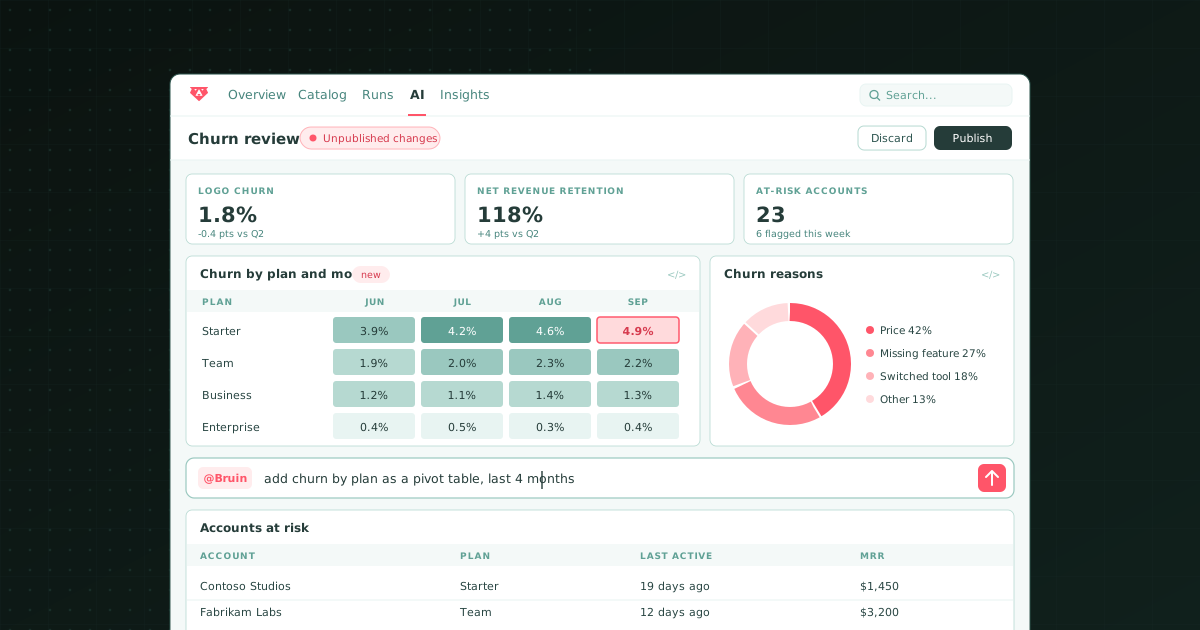
The best Claude Dashboards alternatives in 2026 are Bruin, Hex, Omni, Sigma, Lightdash, the ChatGPT Data agent, Basedash, and Looker. Claude Dashboards, which Anthropic released in beta on 8 October 2026, builds a live dashboard by writing a SQL query per chart against Snowflake, BigQuery, Databricks, Redshift, or ClickHouse. Anthropic describes it as designed for quick, exploratory questions and ships an export to BI tools for deeper work. The alternatives split by what you need next: Bruin if you want AI dashboards on data that is loaded, modelled, checked, and traced in one platform; a BI tool such as Omni, Sigma, or Looker if you want a governed semantic model on a warehouse you already run; Hex for notebooks; and the ChatGPT Data agent if your company runs on ChatGPT.
We have described each tool the way its own team would and named the cases where you should pick something else. We build Bruin, so weigh our view of it accordingly.
When Claude Dashboards is enough
Before the list: you may not need an alternative. If your warehouse is already modelled and tested by a data team, and the question is a one-off ("compare this week's signups with last month's"), Claude Dashboards is excellent. Every chart shows its query and last refresh time, live queries respect each viewer's permissions, and the same Claude can explain the number. Teams usually start looking further for one of four reasons:
- Shared definitions. Claude writes SQL per chart, so two dashboards can define the same metric differently.
- Tested data. Claude queries the warehouse as it is and cannot see a failed load.
- Dashboards as code. A Claude dashboard is an artifact on claude.ai, not a reviewed file in your repository.
- Answers outside Claude. Teams that ask in Slack, Microsoft Teams, or WhatsApp want the same numbers there.
The alternatives at a glance
| Tool | What it is | Prompt to dashboard | Loads and models data | Open source | Best for |
|---|---|---|---|---|---|
| Bruin | AI data platform with AI dashboards | Yes | Yes | Yes (CLI, dac) | AI dashboards on data it loads, models, checks, and traces |
| Hex | AI notebook with shareable apps | Partial, in a notebook | No | No | Analysts who work in SQL and Python notebooks |
| Omni | BI with governed metrics and AI exploration | Partial, on a model | No | No | Governed self-serve BI on a modelled warehouse |
| Sigma | Spreadsheet-style BI on the warehouse | Partial | No | No | Teams that think in spreadsheets |
| Lightdash | Open-source BI on dbt, with an AI agent | Partial, via the agent | No: reads a dbt project | Yes | Teams already standardized on dbt |
| ChatGPT Data agent | Warehouse query and dashboard plugin in ChatGPT Work | Yes | No | No | ChatGPT Work customers with a governed warehouse |
| Basedash | AI-native dashboards from your database | Yes | No | No | Startups that want quick charts with little setup |
| Looker (with Gemini) | Governed BI on a LookML semantic model | Partial, via Gemini | No: models semantics in LookML | No | Enterprises with a LookML model |
The shortlist
1. Bruin
Bruin is the best Claude Dashboards alternative for data teams that want AI dashboards on data they also load, model, check, and trace.
What it is: an open-source, AI-powered data platform whose agent builds dashboards from a chat prompt in Bruin Cloud, on data the same platform loads with ingestr, transforms in SQL and Python, protects with quality checks, and traces with column-level lineage.
Why teams pick it over Claude Dashboards: the dashboard reads shared semantic and named queries, so "revenue" is defined once and every dashboard inherits it. A failed check stops the run before a stale table reaches a chart. Dashboards can also live in your repository as YAML or TSX files with Bruin's open-source dac, and the same agent answers in Slack, Microsoft Teams, Google Chat, WhatsApp, Discord, Telegram, email, and the browser.
Watch-outs: you get the governed layer by letting Bruin build the pipeline, which is real setup the first time. Bruin is a data platform, not a general assistant, so it will not draft your memo the way Claude will.
Best for: data teams that want AI dashboards on data they can vouch for, without stitching ingestion, transformation, and BI together. Many teams also point Claude at the tables Bruin builds; see Claude Dashboards vs Bruin.
2. Hex
What it is: a collaborative notebook that blends SQL, Python, and an AI assistant, with dashboard-style apps as the output. It is one of Claude Dashboards' export destinations.
Why teams pick it: analysts love it. When a quick Claude dashboard turns into a real investigation, Hex is where the SQL and Python live.
Watch-outs: it is built for people comfortable with notebooks, and it queries data a separate pipeline has loaded.
Best for: data teams that want AI-assisted analysis and polished, shareable apps.
3. Omni
What it is: an analytics platform that combines governed metrics with AI question-and-answer, so users can explore without prebuilt dashboards. Also a Claude export destination.
Why teams pick it: it pairs the consistency of a semantic layer with the flexibility of ad-hoc exploration, which is the gap Claude Dashboards leaves open.
Watch-outs: you still invest in modelling to get the governed-metrics benefit, and the pipeline lives elsewhere.
Best for: governed self-serve BI on a warehouse you already model.
4. Sigma
What it is: a spreadsheet-style BI tool on the warehouse, with a familiar grid interface on live data. Another Claude export destination.
Why teams pick it: finance and operations teams who think in spreadsheets get warehouse-scale data without learning a new metaphor.
Watch-outs: it is a BI application to adopt and model into, on a pipeline you run separately.
Best for: teams whose users think in spreadsheets.
5. Lightdash
What it is: open-source BI built on dbt. Metrics and dimensions live in your dbt project, and Lightdash exposes them through a web app, dashboards, and an AI agent that answers in Slack and the app.
Why teams pick it: the metric definitions Claude Dashboards lacks already live in dbt YAML, versioned in git.
Watch-outs: it assumes a maintained dbt project, and ingestion and orchestration live in other tools.
Best for: teams already standardized on dbt.
6. ChatGPT Data agent
What it is: a plugin in ChatGPT Work, invoked with @Data, that queries Snowflake, BigQuery, Databricks, Redshift, ClickHouse, and MongoDB under your existing permissions, reads definitions from dbt or Snowflake Horizon if you have them, and builds dashboards in ChatGPT or in tools such as Power BI, Tableau, Sigma, and Omni.
Why teams pick it: it is the closest like-for-like to Claude Dashboards for a company that standardized on ChatGPT instead of Claude.
Watch-outs: like Claude, it is as good as the warehouse behind it; it does not load, model, or check data. See ChatGPT vs Bruin.
Best for: ChatGPT Work customers with a governed warehouse.
7. Basedash
What it is: an AI-native tool that turns plain-English descriptions into SQL and builds dashboards directly from your database.
Why teams pick it: a fast prompt-to-dashboard flow with very little setup, in a dedicated BI app rather than a chat product.
Watch-outs: lighter on governance and semantic modelling than the BI suites, so better for speed than for finance-grade reporting.
Best for: startups that want charts without standing up a BI stack.
8. Looker (with Gemini)
What it is: Google's governed BI platform, with Gemini for conversational analytics on top of its LookML semantic model. Anthropic lists Looker as a coming-soon Claude export destination.
Why teams pick it: the semantic model makes answers consistent across every dashboard, which is the main thing Claude Dashboards does not do.
Watch-outs: LookML modelling is a substantial up-front investment, and the pipeline is a separate project.
Best for: enterprises with a LookML model already in place.
How to choose
Ask where the trust in the number should come from.
- If it should come from a data team that already maintains a clean warehouse, Claude Dashboards may be all you need, and a BI tool such as Omni, Sigma, or Looker adds the governed model on top.
- If it should come from definitions in dbt, pick Lightdash.
- If it should come from the pipeline itself, because you do not have a modelled warehouse yet or you want loads, checks, lineage, and dashboards in one place, pick Bruin.
- If it should come from an analyst working in code, pick Hex.
Best tool by need
- AI dashboards on data that is loaded, modelled, checked, and traced in one platform: Bruin.
- Dashboards as code in your own repository, open source: Bruin (dac).
- The same numbers in Slack, Microsoft Teams, or WhatsApp as on the dashboard: Bruin.
- Notebook-first analysis with shareable apps: Hex.
- Governed self-serve BI on a modelled warehouse: Omni.
- Spreadsheet-style BI on live warehouse data: Sigma.
- Open-source BI for a dbt shop: Lightdash.
- The Claude Dashboards equivalent for a ChatGPT company: ChatGPT Data agent.
- Quick charts from a database with little setup: Basedash.
- Enterprise BI on a LookML model: Looker.
- A quick dashboard for a one-off question on a clean warehouse: Claude Dashboards itself.
For the broader category, see the best AI dashboard builders in 2026, and for whether any of this replaces a BI tool, read can Claude Dashboards replace your BI tool?.